Last-Mile Delivery Is Changing Shape: E-Quads, Micro EVs and What Honda’s Entry Signals
The last mile is the expensive mile. Industry analyses consistently put the final leg of delivery, from the local depot to the customer’s door, at roughly half the total cost of moving a parcel, and it is the leg that fights traffic, parking, emissions rules and impatient delivery windows all at once. That cost pressure is why the vehicles doing the job are changing shape, and why a company the size of Honda decided the answer looks less like a van and more like a very serious bicycle.
Here is what is happening to last-mile delivery vehicles, what Honda’s electric quadricycle actually is, and what the shift means for urban freight.

Why Vans Stopped Being the Automatic Answer
A full-size delivery van is a fine tool for a suburban route and an increasingly poor one for a dense city core. It idles in double-park positions, burns driver time hunting for curb space, and cities keep shrinking the space it is allowed to occupy: low-emission zones, congestion pricing, delivery-hour restrictions and curb management programs all tax the van model in the places parcel volume is growing fastest.
The industry’s response has been to split the last mile by density. Vans keep the spread-out routes. For the dense core, parcels increasingly move from micro-hubs, small urban depots fed by trucks, onward by cargo bike, e-trike and now e-quad, vehicles that use bike infrastructure, park where vans cannot, and cost a fraction per mile to run.
What an E-Quad Is, and What Honda Announced
An electric quadricycle sits deliberately between bicycle and car: four wheels for stability and cargo volume, pedal-assist or low-power electric drive to qualify for bike-lane-class rules in many cities, a weather-protected operator, and swappable cargo modules in the hundreds-of-pounds class. It is a purpose-built answer to a narrow question: how do you move a van-load’s worth of parcels through streets where a van is the slowest vehicle on the block?
Honda’s entry, announced in 2025 under its new Fastport brand, is exactly this shape of machine: a pedal-assist cargo quadricycle designed for bike-lane operation, built around Honda’s swappable battery packs so a depot can exchange batteries in seconds rather than park vehicles to charge, with planned production in the United States at Honda’s Ohio manufacturing operations. The significant part is less the specification than the signature: a global automaker committing manufacturing capacity to a vehicle category that until recently belonged to startups and bicycle companies.

Honda is not alone. The major parcel networks have run cargo-bike and micro-EV pilots across American and European cities for years, and several operate them at scale in Europe, where the micro-hub model matured first. The pattern repeats: regulation squeezes vans in the core, an operator pilots micro-vehicles, the pilot quietly becomes the permanent fleet.
What It Means for Urban Freight
The depot moves closer to the customer. Micro-vehicles have short legs, so the model only works with small hubs inside the delivery zone. Expect more micro-depots in parking structures, retail backspaces and underused urban industrial lots, fed by trucks at night, emptied by quads all day.
Battery swapping beats fast charging at fleet scale. A delivery vehicle earns nothing while charging. Swappable packs, the approach Honda built its quad around, turn energy into a thirty-second pit stop, and that logic is why swap systems keep appearing across the small end of electric freight even as fast-charging wins the passenger car argument. The infrastructure side of that story is covered in our page on charging infrastructure for freight.
The van does not die; it retreats. Suburban and rural last-mile stays motorized at full size, and the middle mile that feeds the micro-hubs still belongs to trucks. What changes is the core-city curb, which is exactly where the pain was.
Emissions math improves where it is watched hardest. Replacing diesel van-miles in dense cores with electric quad-miles is a visible, measurable win of the kind covered in our page on fleet emissions technology, and it is the kind cities reward with access rules that further tilt the field.

The Transport Angle Nobody Mentions
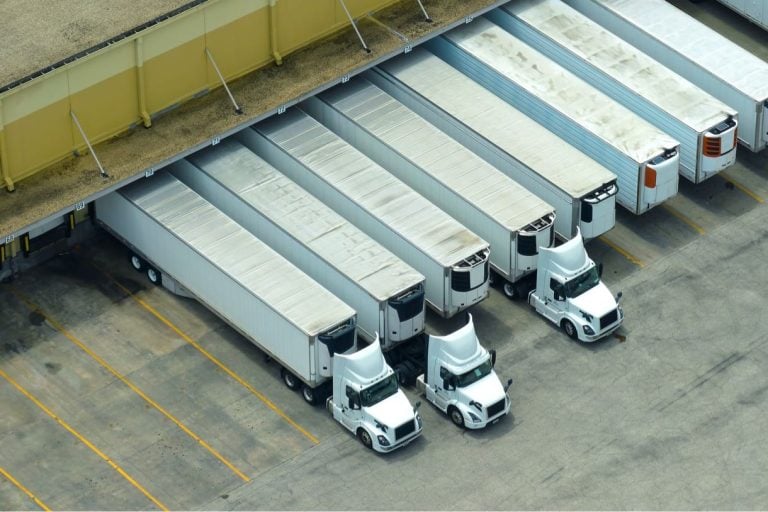
Here is the detail from our corner of the industry: micro-EVs do not drive themselves to work. A bike-lane-class quadricycle is not highway-legal, which means every fleet deployment is also a freight movement, from factory or port to depot, by truck. Fleets of them move palletized or in enclosed trailers, the same way we already move golf carts and low-speed vehicles: forklift-friendly, battery states documented, chargers and swap cabinets riding as accompanying freight. As micro-fleets spread from pilot cities into every mid-size downtown, that depot-to-depot repositioning becomes a steady freight lane of its own, and it is one a specialized broker handles routinely today.
What to Watch Next
Three markers will say whether the e-quad becomes standard American street furniture or stays a coastal pilot. First, curb and lane rules: every city that formalizes cargo-bike lane access and micro-hub zoning makes the vehicle class more investable, and those ordinances are spreading. Second, the used-fleet market: when the first generation of delivery quads cycles out and a resale market appears, the category will have proven it holds value like equipment rather than depreciating like a gadget. Third, service networks: an automaker’s dealer and parts infrastructure behind a bike-lane vehicle is precisely the boring, unglamorous advantage that decides whether fleet managers trust the category with daily volume, and it is the strongest card an entrant like Honda brings to the table.
Common Questions
What is an electric quadricycle? A four-wheeled, pedal-assist or low-power electric cargo vehicle sized and regulated closer to a bicycle than a car, built for dense-city delivery.
What did Honda announce? A pedal-assist cargo e-quad under its Fastport brand, announced in 2025, designed around swappable batteries with planned US production in Ohio.
Why not just use electric vans? Electric vans fix emissions but not curb space, parking time or access rules. In dense cores, the vehicle that fits bike infrastructure wins the stop-per-hour math.
Will this replace delivery vans? In city cores, increasingly. On suburban and rural routes, no; the van and the truck keep the miles that fit them.
How do micro-EV fleets reach their cities? As freight. They are not highway vehicles, so deployments ship by truck to urban depots, the same specialized lane used for LSVs and golf carts.
Get a Quote
Call Ship A Car, Inc. at (866) 821-4555 with what you are moving and both zip codes, or request an estimate for the move through the quote calculator.