Buying a Car Online: Should You Ship It or Collect It?
Buying a car sight unseen from another state is now ordinary, and the decision that catches people out is not the purchase but the collection: fly out and drive it back, or have it shipped. The answer depends on distance, on what the car is worth, and on how much you trust a vehicle you have never driven to cover a thousand miles on its first day with you.

Protect Yourself Before the Money Moves
Everything else on this page matters less than this section, because the transport is easy and a bad purchase is not.
Get daylight photographs of every panel, plus the wheels, the lower bumpers, the rocker panels, the roof and the interior. Ask for a short video of a cold start and one of the car driving. A seller who will not provide these has told you something.
Run the vehicle identification number through a history report and read it properly: title brands, odometer discrepancies, accident records and how many owners. A salvage or flood title is not automatically a bad buy but it changes the value dramatically.
Pay for a pre purchase inspection by an independent mechanic near the seller. It costs a small fraction of the car and it is the single highest value thing you can spend money on in a remote purchase. Several national services will do this.
Verify the title is clean, in the seller’s name, and free of liens. And use a payment method with a record. Never wire money to a private seller you have not verified.
The Case for Flying Out and Driving Back
It has real advantages and they are worth stating honestly.
You see the car before you pay. That is the big one, and no photograph or inspection report replaces sitting in a vehicle and driving it. If something is wrong, you walk away with your money.
On a short distance it is also cheaper. Under roughly 500 miles the drive is a day and the shipping quote is at its highest per mile.

And some people simply want the drive. A car you have just bought, on an interesting road, is a good day rather than a chore.
The Case for Shipping It
The arguments the other way are mostly about risk and arithmetic.
An unfamiliar used car is at its least predictable on its first long trip. You do not know its service history in practice, how the tires are wearing or whether the cooling system copes. A breakdown 800 miles from home, in a car you bought yesterday, is an expensive and unpleasant education.
The drive is rarely as cheap as it looks either. Count the airfare, fuel, a night or two of lodging, meals and your own days. On a long trip that total frequently exceeds the shipping quote.
Shipping also adds no miles. On a low mileage or collector vehicle those miles have real value, and a 1,200 mile drive is a measurable dent in it.
And it removes the temporary registration and insurance problem, since the car travels on a truck rather than on public roads in your name.
Registration, Plates and Insurance
This is the administrative trap in a remote purchase and it applies either way.
Your insurance must be active from the moment you take ownership, not from when the car reaches you. Call your insurer with the VIN before you pay.
If you are driving it home, you need to be legally on the road: either a temporary permit from the seller’s state, a transit tag, or in some cases the seller’s plate under specific conditions. This varies by state and it is worth confirming rather than assuming.
If you are shipping it, none of that applies to the journey, but you still have to title and register in your own state within its deadline, commonly 30 to 90 days.

If the Car Does Not Run
A surprising number of remote purchases are projects, and this changes the transport materially.
An inoperable vehicle cannot be driven home at all, so shipping is the only option. It needs a carrier with a winch, and it costs more than a running car on the same lane. Say so when you book rather than at pickup.
Establish whether it rolls, steers and brakes, because a car that does none of those needs different equipment again.
Arranging the Shipment
Coordinate the handover before you book. Agree who releases the car, get a working phone number for the seller, and give the carrier both. A driver who cannot reach anybody at pickup moves on to the next load.
Have the seller present at collection if you can, and ask them to photograph the car as it loads. That is your condition baseline against the driver’s own report.
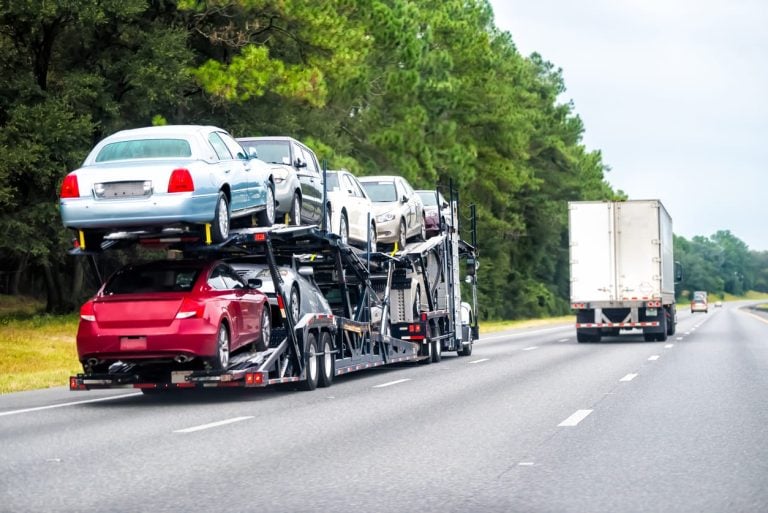
Choose open transport unless the car is a collector vehicle, has fresh paintwork or sits very low. Book two to three weeks ahead with a range of dates rather than one. Our comparison of transport options covers the service choice.
At delivery, inspect before signing, compare against the seller’s photographs, and note anything unexpected on the bill of lading while the driver is present.
Common Questions
Is it safe to buy a car sight unseen? Reasonably, with a history report, daylight photographs, a video of it running and an independent pre purchase inspection near the seller.
Which is cheaper, flying out or shipping? Under about 500 miles, driving usually. Past 1,000 miles, shipping frequently wins once airfare, lodging and your time are counted.
What if the car does not run? Shipping is the only option, and it needs a winch equipped carrier at a higher rate. Declare it when booking.
Do I need insurance before it ships? Yes, from the moment you own it. Cargo insurance covers transit damage, not your ownership.
What is the single best protection? An independent pre purchase inspection. It costs a fraction of the car and it is the only thing that sees what photographs cannot.
Get a Quote
Call Ship A Car, Inc. at (866) 821-4555 with both zip codes, the vehicle and whether it runs, or request an estimate for the move through the quote calculator.