How to Ship a Large Water Tank
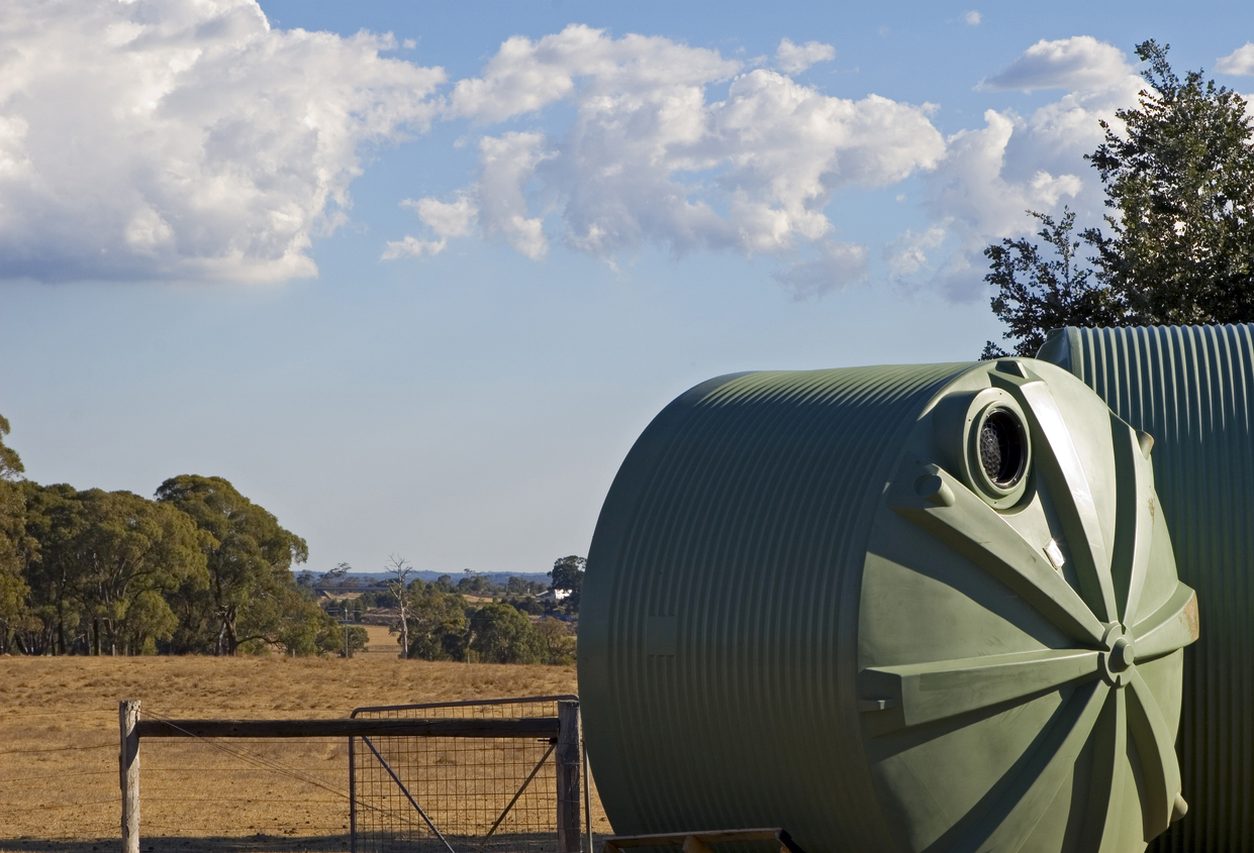
An empty water tank is light for its size and almost always wider or taller than legal, which makes this a dimension problem rather than a weight one. A 2,500 gallon poly tank runs around 8 feet across; a 5,000 gallon is closer to 10; larger agricultural and industrial tanks go well past that. Legal width is 8 feet 6 inches and legal height is 13 feet 6 inches measured from the road, so the diameter and the deck height together decide whether you need a permit.
It Ships Empty, Without Exception
Water weighs a little over eight pounds per gallon, and that arithmetic ends the conversation quickly.
A 2,500 gallon tank full holds over 20,000 pounds of water. A 5,000 gallon tank holds more than 40,000. Nobody transports that, and no carrier would accept it: the weight alone would push a routine load into overweight permit territory, and a partially full tank is worse still because the water surges as the truck moves.
Drain it completely and leave the outlets open long enough to be sure. Then check the fittings, the sump and any internal baffling, because residual water in a tank crossing freezing states is a split fitting waiting to happen.
Diameter Is What Triggers the Permit
Tanks are round, and a round object does not compress to fit a legal envelope.
Past 8 feet 6 inches wide the load needs a permit for every state on the route. Around 12 feet, depending on the state, it needs a pilot car; wider again and it needs two plus route restrictions. Those thresholds are set per state, so the escort count can change at a border.
Height is the other half. A flatbed deck sits around 5 feet off the road, so a 9 foot diameter tank on a flatbed is already at 14 feet and over the limit. A step deck buys roughly a foot and a lowboy buys more, and on a tank that is often the difference between a permit and no permit.
Measure the tank at its true widest point, including any molded ribbing, fittings or a top mounted manway, rather than working from the catalog diameter.
Vertical or Horizontal
How the tank sits on the deck changes the whole load, and the answer depends on the tank.
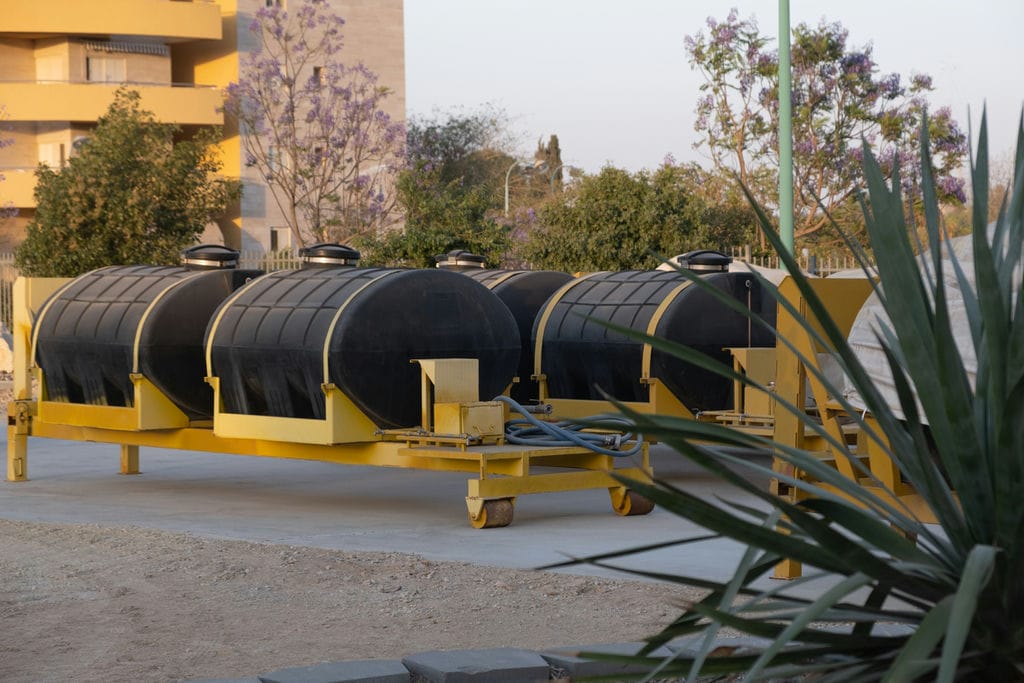
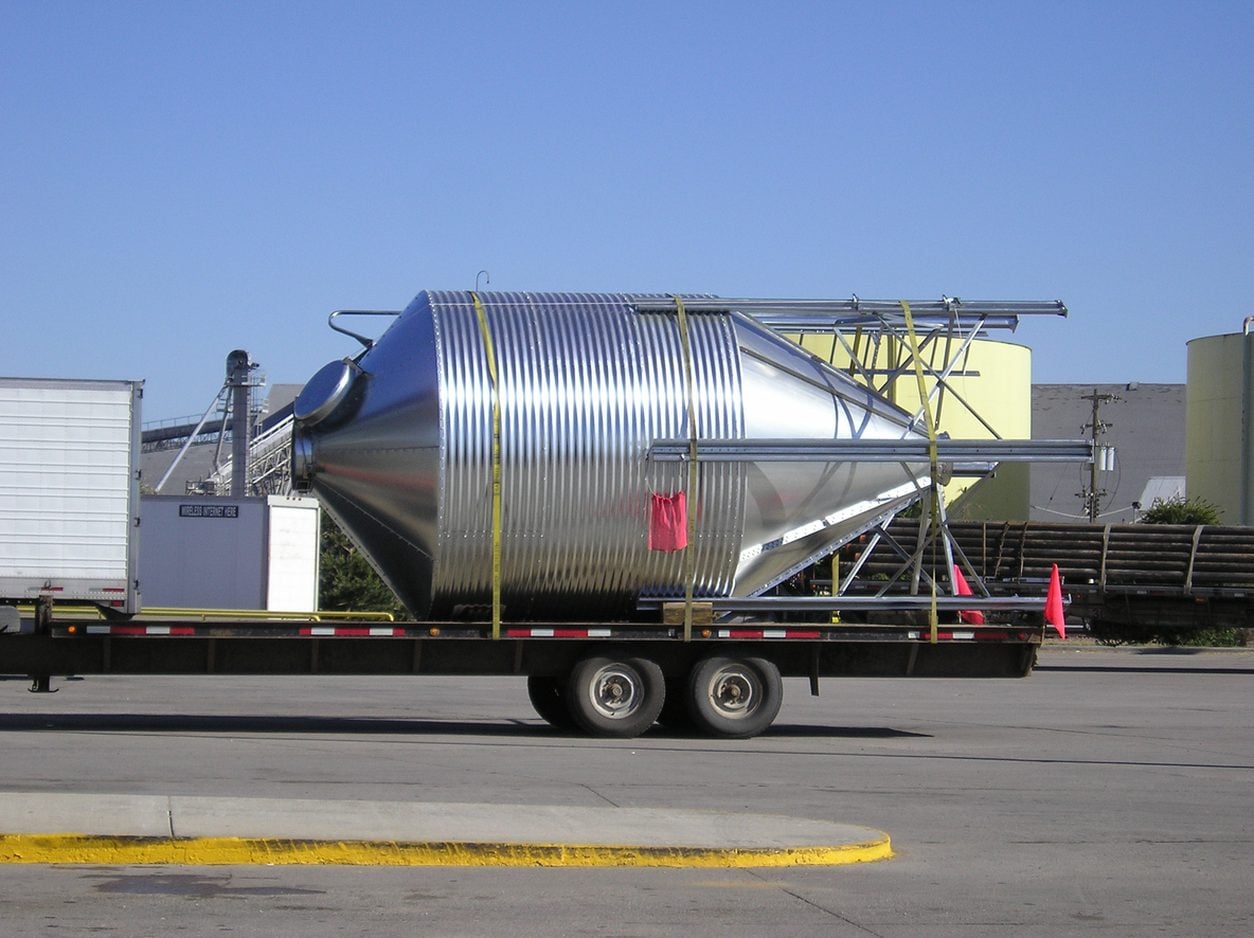
A horizontal or leg mounted tank travels on its side as designed, which keeps the height down and gives a stable footprint. That is the easy case.
A vertical tank is the awkward one. Standing upright it is frequently too tall for any deck, so it often travels on its side, and a vertical poly tank was not designed to carry its own weight that way. It needs cradling in shaped supports that spread the load along the wall rather than resting on a single point, and it needs securing so it cannot roll.
Ask the manufacturer how theirs should travel. Many publish transport guidance, and following it is the difference between a tank that arrives round and one that arrives oval.
Poly, Steel and Fiberglass Behave Differently
The material decides how careful the strapping has to be.
Polyethylene tanks are the most common and the most easily damaged. They flex, and a ratchet strap pulled hard onto an unsupported span will deform the wall or crack it, particularly in cold weather when the material is less forgiving. Wide webbing over padded areas, never a narrow strap onto bare plastic.
Steel tanks tolerate strapping better but are far heavier, which brings weight back into the calculation and can mean a different trailer.
Fiberglass sits between the two: strong in the structure, fragile in the gelcoat, and a chip is both cosmetic and a potential leak path. Treat it like the pool shells it is related to.
Lifting at Both Ends
A tank does not roll and cannot be dragged, so something has to lift it twice.
That means a crane, a telehandler or a heavy forklift at the origin and at the destination. Arranging equipment at one end only stops the move halfway, and it is the most common cause of a failed tank delivery.
Confirm the lifting points before the lift. Many tanks have molded or welded lugs and slinging from anywhere else distorts the shell. On a large poly tank, a sling around the body without spreaders will pinch it.
Check ground conditions and overhead clearance at both sites too. A farm or industrial yard often has soft ground, and overhead power lines are a genuine hard stop on a crane lift.
Travel Windows and Wind
Once a tank is a permitted load, the legal windows rather than the mileage set the schedule.
Permitted loads generally move in daylight, on weekdays, outside peak hours, and many states close permitted movement over holiday periods. They also do not move in high wind, and a large empty tank is essentially a sail: light, bulky and with an enormous surface area. Wind stops these loads more often than it stops most freight.
Build slack into the schedule accordingly, particularly on an exposed route or in spring.
Site Access Decides the Equipment
Tanks usually go to a farm, an industrial yard or a residential property, and the last hundred yards is where these moves succeed or fail.
A truck of around 70 feet plus a crane needs room to get in, position and set up, and the ground has to carry the lifting equipment rather than just the tank. Farm tracks and rural yards are frequently soft, and a crane sinking a foot into wet ground is the end of that day.
Check the gate width, the overhead clearance including trees and power lines, the surface, and where exactly the tank has to end up. If it is being set on a prepared pad or a ring beam, confirm that is poured and cured before the delivery date, because a tank cannot sit on the street waiting. Our guide to shipping fiberglass pools covers the same access problem on a related load.
Common Questions
Can a tank ship with water in it? No. Water is over eight pounds per gallon, so even a modest tank full would be an overweight load, and it surges in transit.
Does a water tank need a permit? Usually. Past 8 feet 6 inches wide or 13 feet 6 inches high measured from the road, for every state on the route.
Can a vertical tank travel on its side? Often yes, but it needs shaped cradles that spread the load, because it was not designed to rest that way.
Do I need a crane at both ends? Yes, or a telehandler or heavy forklift. Arranging one only at the origin stops the move halfway.
Why does wind matter? A large empty tank is a sail. Permitted loads do not move in high wind, which is a common cause of delay.
Get a Quote
Call Ship A Car, Inc. at (866) 452-3657 for heavy haul and specialized freight, with the tank’s measured diameter and height, the material, and the lifting arrangements at both ends.