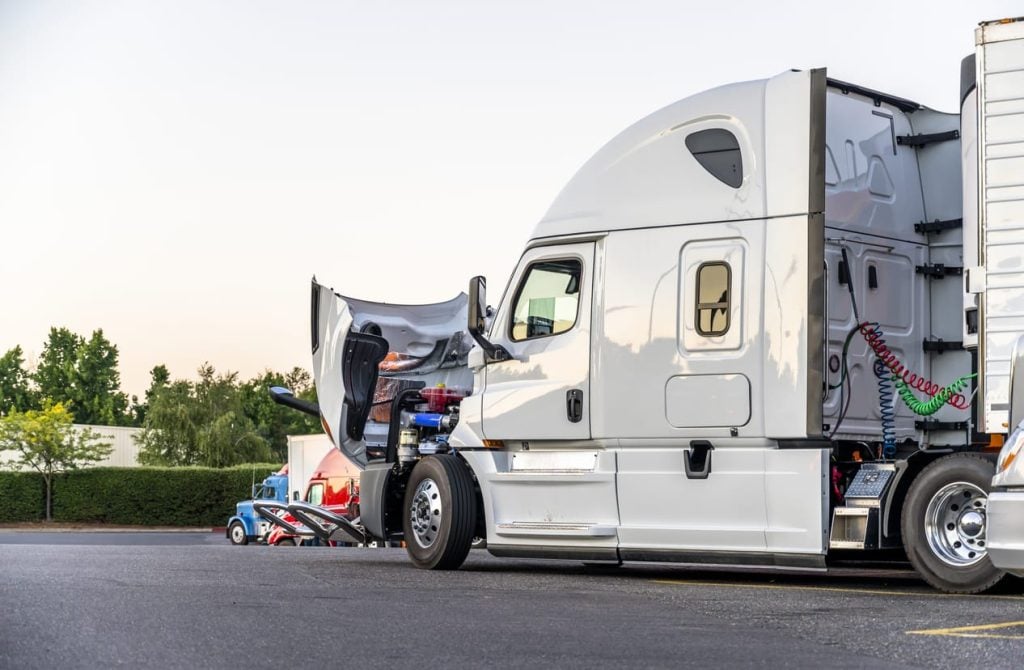
How Carrier Maintenance Programs Affect Your Shipment
Whether a carrier maintains its trucks by schedule, by sensor data, or by waiting for something to break is invisible when you book and highly visible if it goes wrong. A breakdown with your vehicle on the trailer is not a mechanical problem you can help with; it is a delivery date that moves by days. This is what the different approaches actually mean.

Three Ways to Maintain a Truck
Reactive. Fix it when it fails. Cheapest per repair and by far the most expensive overall, because failures happen at the worst possible moment and take the truck out of service wherever it happens to be.
Preventive. Service on a schedule, by mileage or hours, regardless of condition. This is the industry baseline and it works. Its weakness is that it replaces some parts too early and still misses failures that develop between intervals.
Predictive. Use data from the vehicle to service a component when it is actually degrading rather than when the calendar says so. This is what fleets with telematics have been moving toward, and it is the one that changes outcomes most.
What the Data Actually Sees
Modern tractors generate a great deal of information, and the useful part is that most failures announce themselves before they happen.
Engine control data flags fault codes and parameter drift. Oil analysis detects wear metals and contamination that indicate a bearing or a seal going. Brake and tire monitoring catches wear and pressure loss. Battery and charging system data predicts the no-start that would otherwise happen on a cold morning three states away.

A fleet that watches these can pull a truck in for a two hour repair at its own yard rather than having it stop on an interstate. The cost difference is enormous, and so is the difference to your delivery date.
Why This Reaches Your Shipment
Three ways, in order of how much they matter to you.
Breakdowns. A truck that stops with your vehicle on it waits for a repair. In an unfamiliar town on a weekend, that is easily a day or two, and the load does not simply transfer to another carrier.
Out-of-service inspections. Brakes, tires and lights are consistently the largest categories of roadside violations, and all three are maintenance items. A carrier with a poor maintenance program collects out-of-service orders, and each one is a stopped truck.
Rates over time. Maintenance is a real operating cost, and the trend has been upward: newer emissions systems and more electronics mean more expensive repairs and fewer that a driver can do at the roadside. That cost reaches rates like any other.
Why Maintenance Costs Have Risen
It is worth understanding why this has become a bigger line in every carrier’s budget, because it is one of the quieter reasons rates have moved.
Emissions aftertreatment is the largest single factor. Diesel particulate filters, selective catalytic reduction systems and the sensors that manage them are expensive to service and expensive to replace, and a fault in one can put a truck into a reduced power mode that takes it off the road entirely. None of that existed on a tractor from twenty years ago.
Electronic complexity is the second. More of a modern truck is software and sensors, which means more diagnostic time and fewer repairs a driver can complete at the roadside with hand tools. A fault that would once have been a thirty minute fix is now a tow to a dealer with the right diagnostic equipment.
Parts availability and technician shortages compound both. A truck waiting for a part is a truck earning nothing, and skilled diesel technicians are in short supply, which raises labor rates and lengthens the wait.
The net effect is that the gap between a well run maintenance program and a poor one has widened. Deferring maintenance used to produce a roadside repair; increasingly it produces a truck sitting at a dealer for a week.
The Driver Inspection Nobody Sees
One more layer worth knowing about, because it is a legal requirement rather than a courtesy.
Drivers are required to perform a pre-trip inspection and to submit a written report on the vehicle’s condition, and defects that would affect safe operation must be repaired before the vehicle is used again. That is the first line of defense, and it works only if the carrier’s culture supports a driver who reports a problem rather than penalizing the delay.
You will not see any of this directly. It shows up in the inspection record, which is precisely why that record is worth five minutes before you book.
How to Tell Before You Book
You cannot inspect a carrier’s workshop, but you can read the record it produces.
Look the company up in the Federal Motor Carrier Safety Administration’s public system using its USDOT or MC number. The inspection history is the useful part: a carrier with many inspections and a low out-of-service rate has been examined repeatedly by people whose job is to find maintenance defects, and has come through.

Look specifically at vehicle maintenance violations rather than the overall count. A pattern of brake and tire findings is a maintenance program telling you about itself. Our guide to what roadside inspections tell you covers how to read it.
Fleet age is a reasonable secondary signal. Newer equipment fails less, and a carrier that invests in replacing tractors is generally the same one that services them.
What It Does Not Guarantee
Worth being honest. Well maintained trucks still break down, tires still fail from road debris, and weather stops everybody equally.
A good maintenance record reduces the probability of a mechanical delay; it does not eliminate it. Treat a delivery date as a range regardless, and judge a carrier by the pattern rather than by a single event.
Common Questions
What is predictive maintenance? Servicing a component when vehicle data shows it degrading, rather than on a fixed schedule or after it fails.
How does it affect me? Fewer breakdowns and fewer out-of-service inspections, both of which stop a truck with your vehicle on it.
What causes most out-of-service orders? Brakes, tires and lights, which are all maintenance items rather than bad luck.
How do I check a carrier? Look up the USDOT or MC number in the FMCSA public system and read the inspection history and out-of-service rate.
Does a good record guarantee on-time delivery? No. It reduces the chance of a mechanical delay. Weather and traffic affect everyone.
Get a Quote
Call Ship A Car, Inc. at (866) 821-4555 with both zip codes and your date range, or price the move with the instant calculator.