Heavy Equipment Shipping in Oregon
Oregon taxes trucks differently from every state around it, and that shows up in your quote. Instead of recovering road costs mainly through diesel tax, Oregon charges commercial vehicles a weight-mile tax based on how heavy the vehicle is and how far it travels in-state. For a heavy haul that is a real line item rather than a technicality, and it is the first thing that surprises carriers running into Oregon from elsewhere. After that, the state divides neatly into three transport environments, and knowing which one your job sits in tells you most of what the move will involve.
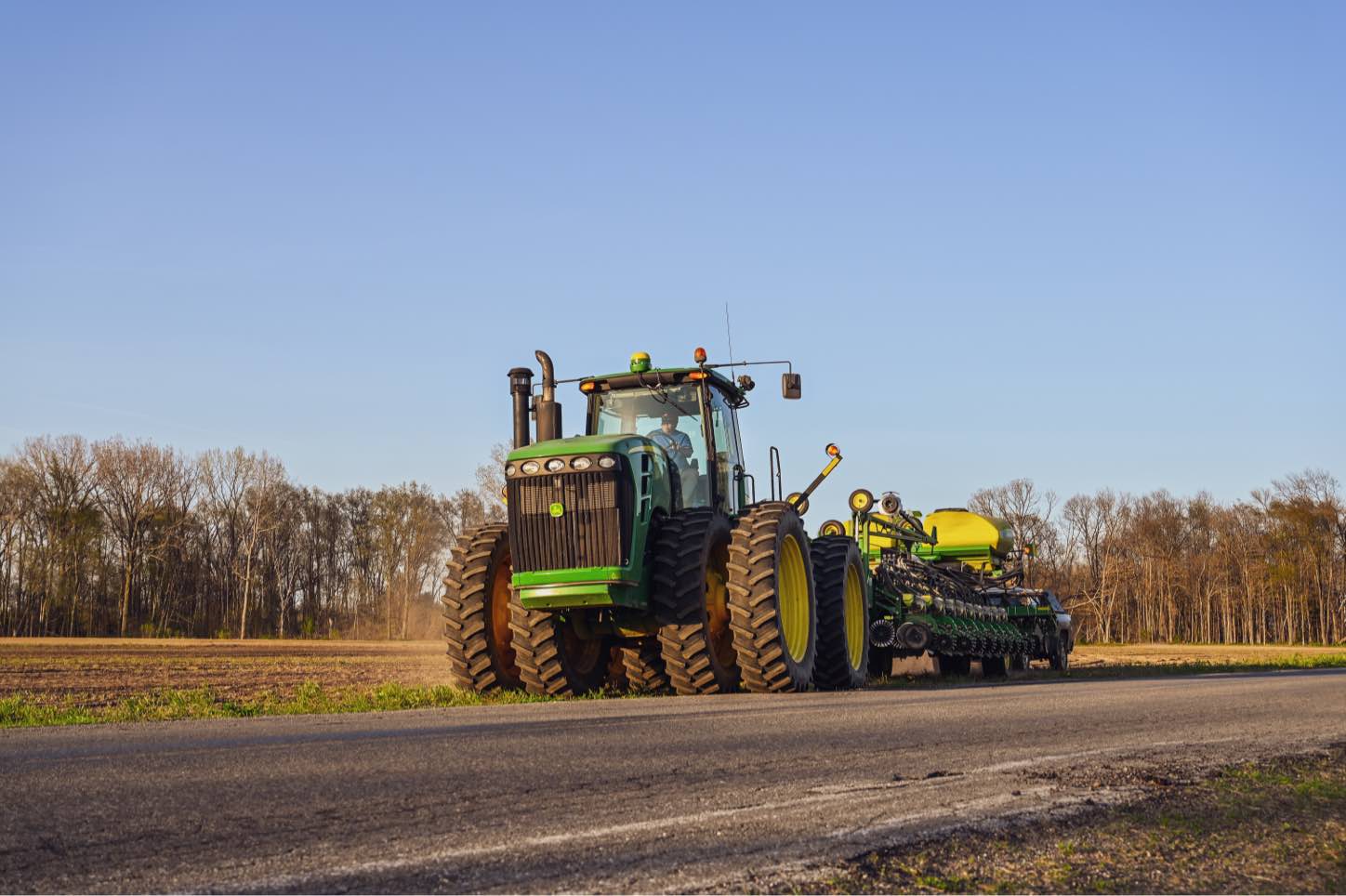
Permit Thresholds
The Oregon Department of Transportation issues oversize and overweight permits, and also administers the weight-mile tax through the same office.
Note the height row. Oregon allows a taller legal load than several neighboring states, which is convenient in-state and a trap the moment the load crosses a border. Plan to the lowest ceiling anywhere on the route.
Three Oregons, Three Jobs
The Willamette Valley, running from Portland south through Salem and Eugene along I-5, holds most of the population, most of the construction and the easiest hauling in the state. Flat, well-served and straightforward.
The coast and Coast Range are a different matter. US-26, US-20 and OR-6 cross the range on winding two-lane roads with tight radii and steep sections. Wide loads struggle here in a way they never do on I-5, and some configurations simply cannot make certain corners.
Eastern Oregon beyond the Cascades is high desert: long distances, few services, and agricultural and energy equipment moving between widely separated points. The roads are easy; the distances and the lack of anywhere to stop are the planning problem.
Timber Still Sets the Rhythm
Forestry equipment is Oregon’s signature heavy haul. Skidders, feller bunchers, yarders, log loaders and processors move constantly among harvest units, and the loading environment is the hard part rather than the highway. Forest roads are narrow, unpaved, frequently steep and often gated, and a lowboy that gets in may struggle to turn around.
Two practical points. Send whatever you can about the access: gate width, surface, grade, and whether there is a landing large enough to load on. And be realistic about rain, because a road that carried a truck in August may not in November.
Rain Is the Constant, Not Snow
Western Oregon’s problem is water rather than ice. Sustained wet weather from autumn through spring softens unpaved ground, and a loaded trailer that sinks is a recovery job costing more than the haul.
The mountain passes do get winter conditions and chain requirements, particularly on I-84 through the Columbia River Gorge and over the Cascade crossings, where wind can also close routes to high-sided loads. Build weather flexibility into the schedule rather than committing to a fixed date between November and April.
Portland, the River and the Port
Portland sits where I-5 meets I-84 and the Columbia River, which makes it the state’s freight hub and gives Oregon something most states lack: a genuine barge option. The Columbia is navigable well inland, and for very heavy or very large single pieces moving between points near the river, water transport can beat road on both cost and practicality.
The Port of Portland handles project cargo and machinery, and port moves run on gate hours and vessel schedules, so the booking rather than the driving determines the timeline.

Trailers for Oregon Work
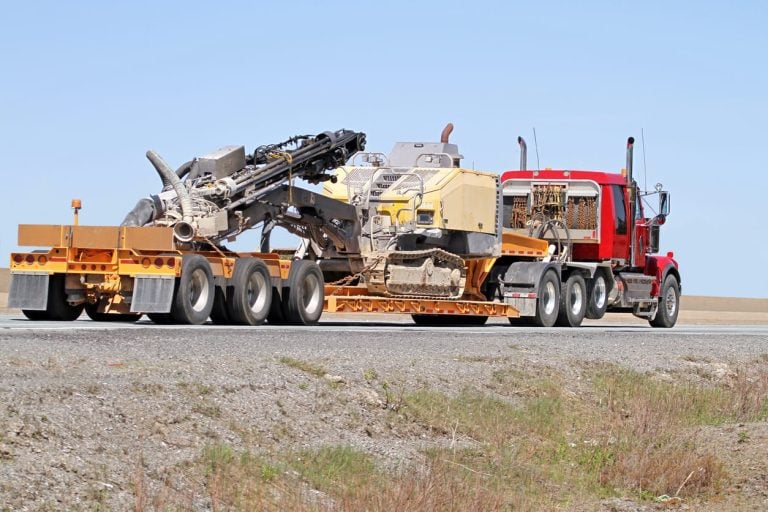
Because so much Oregon equipment loads away from pavement, the removable gooseneck earns its keep here: it drops to ground level so tracked machines walk on without a crane, which matters on a forest landing where no crane is coming. For legal-height loads on I-5 a flatbed is cheapest, a step deck buys clearance for taller machines, and a double drop handles the tallest.
Preparing the Machine
- Wash the machine down properly. Oregon mud is heavy and persistent, and a clean machine is one you can actually inspect.
- Take daylight photographs of all sides, the tracks or tires, the undercarriage and the hour meter.
- Follow the manual on fluids and battery isolation for transport.
- Bring the height down: booms stowed, buckets in, arms retracted, ROPS folded if the design allows.
- Take off loose attachments; heavy ones move as separate freight.
- Leave keys with the driver and mention anything unusual about starting a machine that has sat in the wet.
Cost and Timing
Quotes are built from loaded dimensions, working weight and route, with the Oregon weight-mile tax folded in for the in-state miles. A legal-dimension machine on the I-5 corridor is close to ordinary freight pricing. Coast Range or forest access work costs more because it is slower and needs the right trailer, and permitted oversize loads climb again once escorts and a survey are involved.
Allow one to two weeks for a legal load and three to four or more for a permitted one, with extra slack through the wet season.
Common Questions
What is the weight-mile tax? Oregon charges commercial vehicles based on weight and in-state distance rather than recovering costs mainly through fuel tax. Carriers include it in a quote for Oregon miles.
Does Oregon’s 14 foot height help me? In-state, yes. Cross into a state with a lower ceiling and the load becomes oversize there, so plan to the strictest limit on the route.
Can you load from a forest landing? Usually, with a removable gooseneck and honest information about the road, the grade and the turning space.
Is barge worth considering? For very heavy single pieces moving between points near the Columbia, sometimes yes. It is slower and needs terminal handling at both ends.
How bad is winter? Rain and soft ground matter more than snow in the west. The Gorge and the Cascade passes do get chain conditions and wind closures.
Get a Quote
Call Ship A Car, Inc. at (866) 452-3657 with the make, model, working weight, loaded height and a description of the loading site, and we will tell you what the job needs before you commit to a date.