Seasonal Fleet Relocation for Businesses
Moving a fleet is not moving ten cars ten times; it is a scheduling problem where the cost sits in coordination rather than in mileage. Businesses that relocate vehicles seasonally, rental operators, construction firms, resort and agricultural employers, save more by planning the sequence than by negotiating the rate.

Who Actually Does This
Several industries move vehicles on a predictable annual cycle, and each has a different constraint.
Rental and car share operators shift inventory toward demand: to Florida and Arizona for the winter, to the mountain states and the coasts for summer. Volume is high and timing is commercially critical, because a vehicle in the wrong market is dead capital.
Construction and agricultural businesses follow the work, moving crews and support vehicles with the season. Resort and hospitality operators move service fleets between summer and winter properties.
What they share is that the vehicles are earning assets. A day of unnecessary downtime costs more than the transport, which changes the whole calculation about what to optimize for.
Consolidation Is Where the Saving Is
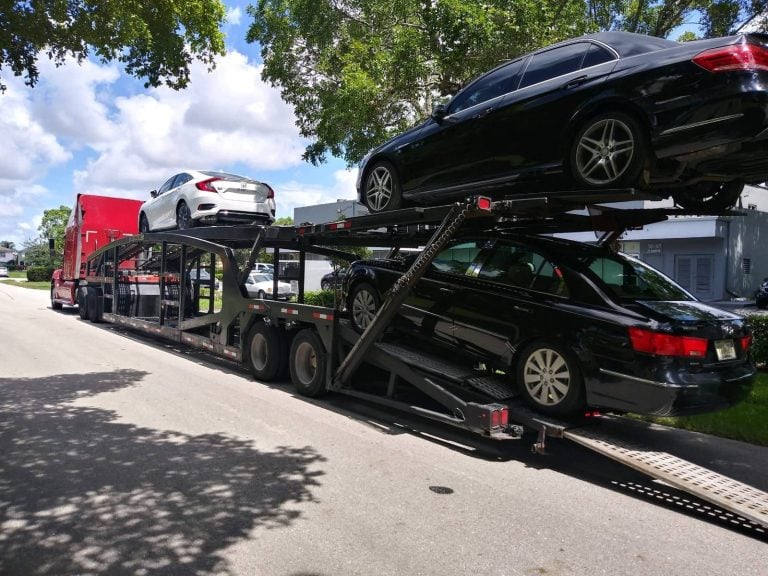
A single open car carrier takes eight to ten vehicles. That is the number to plan around.
Ten vehicles moved together on one truck is dramatically cheaper per unit than ten arranged individually, and it is also simpler: one pickup window, one delivery, one bill of lading set, one point of contact.

The practical implication is that it is worth staging vehicles to a single collection point rather than having a truck visit six locations. Even if that means somebody drives them across town, the consolidation saving usually exceeds the effort.
Where a fleet cannot be consolidated, splitting into full truckloads rather than part loads still helps, because a carrier prices a full deck differently from a partial one.
Book Against the Season, Not the Date
Fleet moves collide with exactly the same peaks as everybody else, and the volume makes it worse.
Summer is the industry crush. The Florida and Arizona snowbird windows in autumn and spring tighten those corridors specifically, which is a problem because that is precisely when rental and resort fleets want to move.
Book four to six weeks ahead for a seasonal fleet move rather than one or two, and give a range of days. A carrier who can slot ten vehicles into a route that is already forming will price it very differently from one asked to build a dedicated run at short notice.
If the operation allows it, moving in waves rather than all at once frequently costs less and reduces the risk of the whole fleet being stranded by one delay.
Driveaway as an Alternative
For some fleet moves, hiring drivers to drive the vehicles rather than trucking them is worth pricing, and it is worth understanding when it does and does not work.
Driveaway can be cheaper on short regional moves, and it needs no specialized equipment. Where it falls down is that every mile driven is mileage added, wear accrued and risk taken on a vehicle that is an earning asset. On a fleet of newer vehicles, or anything under a lease with a mileage allowance, that cost is real and it is frequently larger than the transport saving.
It also needs drivers, insurance that covers them, fuel, and a way of getting them back. Ten vehicles means ten drivers and ten return journeys, and coordinating that reliably is harder than coordinating one truck.
The honest rule of thumb: driveaway for short hops with older vehicles where mileage does not matter, transport for anything long, anything newer, or anything where the fleet needs to arrive together and on a known date.
The Administrative Side
Fleet moves have paperwork that individual shipments do not, and getting it organized in advance is most of the work.
Have a manifest: VIN, year, make, model, whether each vehicle runs and drives, and any modification that affects dimensions. Vehicles that do not run need a winch and an equipped carrier, and one non runner discovered at pickup can hold up an entire load.

Confirm who has authority to release and to receive at each end, and make sure that person can inspect properly, because whoever signs the bill of lading accepts the recorded condition of every vehicle on it.
Check that your commercial policy covers vehicles in transit, since fleet insurance and cargo insurance are different things with different limits. Ask the carrier for their cargo certificate and compare the per-vehicle limit against your fleet’s values.
Preparing the Vehicles
Wash them so existing marks are visible, and photograph each one in daylight including wheels, lower bumpers and rocker panels. On a fleet move this is tedious and it is exactly what protects you, because condition disputes across ten vehicles are far harder to resolve without a record.
Quarter tank of fuel in each, cabins and cargo areas emptied, mirrors folded, alarms disabled, transponders removed and a physical key for every vehicle labeled to its VIN.
Test batteries before collection. Across ten vehicles the odds of one refusing to start are meaningful, and a non starter at loading becomes an inoperable vehicle at a different rate. Our guide to what affects the cost of shipping a car covers the pricing factors.
Common Questions
How many vehicles fit on one truck? Eight to ten on a standard open carrier. That is the number worth planning your batches around.
How far ahead should I book a fleet move? Four to six weeks for a seasonal relocation, and give a range of days rather than a fixed date.
Is it cheaper to consolidate pickups? Usually substantially. Staging vehicles to one collection point beats a truck visiting several locations.
What if some vehicles do not run? Declare them on the manifest. They need a winch and an equipped carrier, and a surprise non runner can hold up a whole load.
Does my fleet insurance cover transit? Not necessarily. Fleet and cargo cover are different policies, so check both and compare per-vehicle limits.
Get a Quote
Call Ship A Car, Inc. at (866) 821-4555 with your vehicle count, both locations and the window you are working to, or price a single unit with the instant calculator.