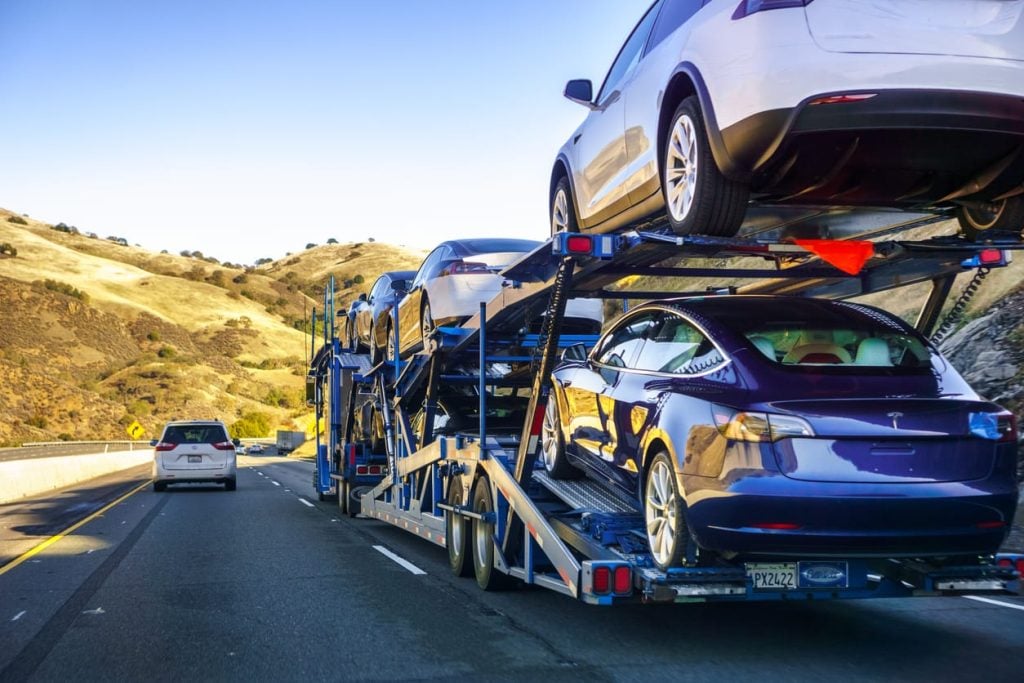
A Model S ships on an ordinary open carrier, and three Tesla specific things decide whether the day goes smoothly: Transport Mode, how the driver gets access without a key, and Sentry Mode quietly draining the battery. None of them are difficult, and all three are settled in five minutes before pickup. Get them wrong and you have a car that cannot be rolled onto a trailer, a driver who cannot move it, or a vehicle that arrives with far less charge than it left with.
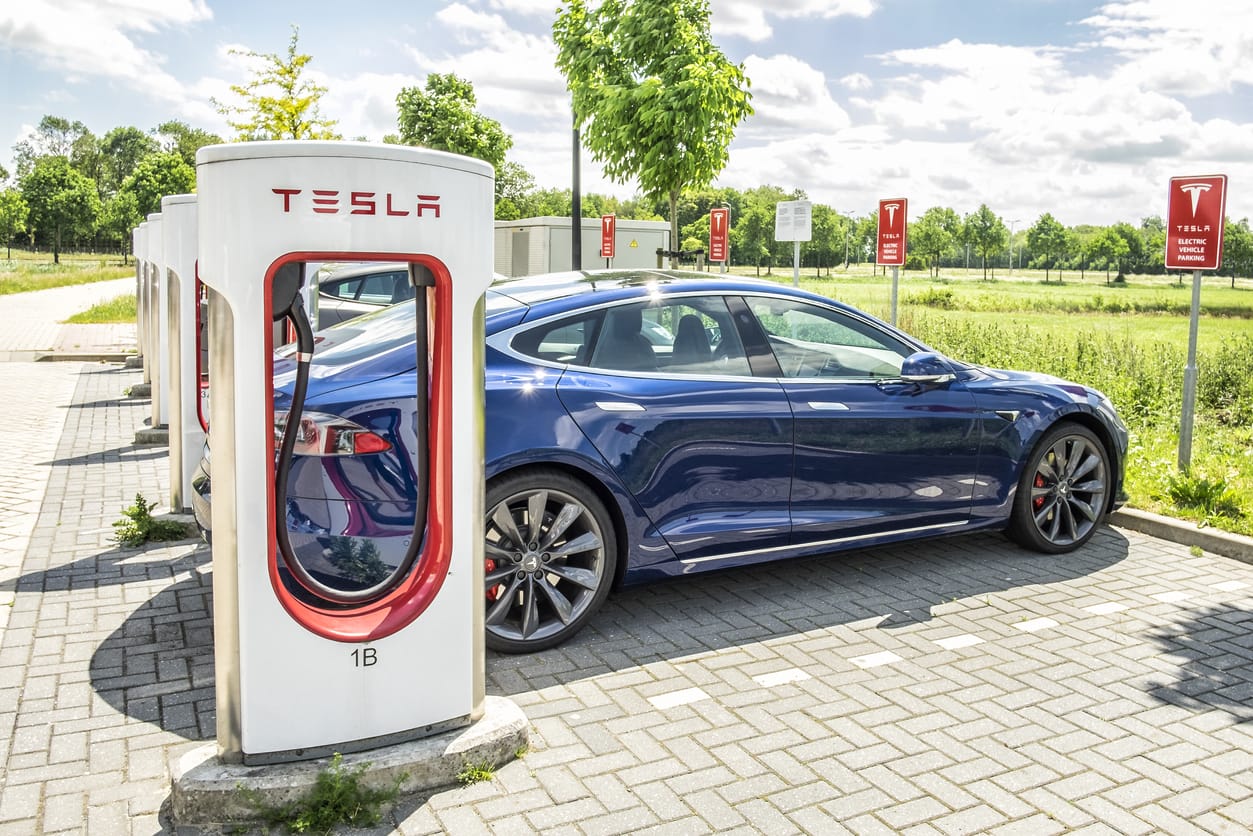
Transport Mode Is the One to Know
A Tesla applies its parking brake electronically, and a car that cannot be driven onto the deck also cannot simply be pushed or winched, because the rear wheels stay locked.
Tesla builds a Transport Mode into the service menu for exactly this situation. It releases the parking brake and allows the car to be rolled or winched a short distance without power to the wheels. If your Model S will not start, will not power up, or has a fault that prevents driving it, this is the first thing to find rather than something to work out at the curb.
Tell your coordinator at booking if the car is not driving normally. A carrier who knows in advance brings the right equipment; one who does not may be unable to load it at all.
The Driver Needs a Way to Move It
There is no conventional key, and that is a genuine practical issue at handover.
The usual answer is to hand over a key card, which is simple and works without a phone. Do not rely on phone key access, since that requires your device to be present and paired, and it will not be at the far end.
Two related points. Make sure PIN to Drive is switched off, or the driver cannot move the car even with a card. And if someone else is receiving the vehicle, arrange how the card gets to them, because a car that arrives with nobody able to move it off the trailer helps nobody.
Turn Sentry Mode Off
Sentry Mode watches the car continuously and it draws power the whole time. Over several days on a trailer that is a meaningful loss, and it is the most common reason a Tesla arrives with far less charge than the owner expected.
Switch it off before pickup, along with cabin overheat protection and any scheduled preconditioning. Those features exist for a car sitting in your driveway, not one strapped to a deck for a week.
Leave the charge somewhere around 30 to 50 percent. That is comfortable for a vehicle sitting several days, it is what most carriers ask for, and it leaves enough to drive off and reach a charger without arriving nearly empty.
What It Costs
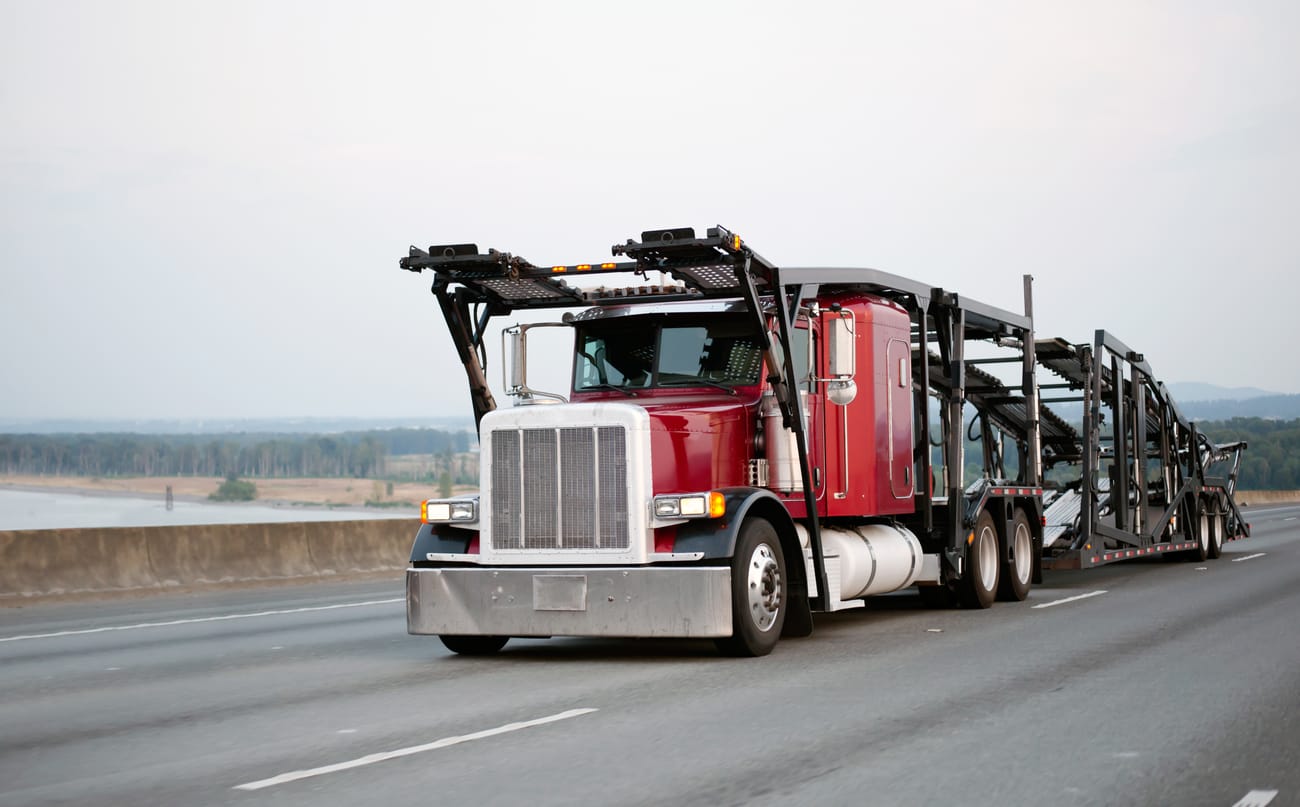
The Model S is a large sedan and a heavy one, since the battery pack adds several hundred pounds over a comparable gasoline car. Expect roughly 10 to 15 percent above a compact sedan on the same lane: around $500 to $1,050 under 500 miles, $1,100 to $1,550 at about 1,000 miles, and $2,200 to $2,900 coast to coast on open transport. Those are planning estimates. Our book holds only four Model S orders since 2023, too few to quote, but across 66 Tesla moves of all models the middle half ran $1,100 to $1,600.
Enclosed transport adds about a third. It is worth it for a car with fresh paint or a wrap, and unnecessary for an everyday Model S.
Air Suspension and Ground Clearance
If your car has adaptive air suspension, mention it. Raising the ride height for loading makes the ramp angle a non issue, and a driver who knows the car has the setting will use it.
Without it, a Model S is low enough that approach angle is worth a thought but not usually a problem on a standard open carrier. If the car is lowered on aftermarket suspension, that changes and enclosed transport with a lift gate becomes the sensible answer.
Preparing It
Standard preparation applies and the pre-pickup checklist covers it. Wash the car so existing marks are visible, photograph every panel in daylight including the roof and the glass, and leave the charge at 30 to 50 percent.
Empty both storage areas, including the frunk, which people forget. Take the charging cable out and leave it at home, since loose equipment is not covered by cargo insurance. Fold the mirrors, and note that the door handles and the large glass roof are the parts worth photographing carefully.
At delivery, inspect before signing. Compare against your photographs and the pickup condition report, check the glass roof and lower panels, wake the car and confirm it drives, and note anything unexpected on the bill of lading while the driver is present.
Common Questions
Does a Model S need special equipment? No. It is a large sedan and fits any open or enclosed carrier.
What if it will not power up? Transport Mode releases the parking brake so it can be winched. Tell the carrier before pickup.
How do I give the driver access? A key card, not phone access, and make sure PIN to Drive is off.
What charge level? Around 30 to 50 percent, and switch Sentry Mode off so it does not drain on the way.
Why does it cost more than a normal sedan? Size and battery weight, typically 10 to 15 percent on the same route.
Get a Quote
Call Ship A Car, Inc. at (866) 821-4555 with both zip codes and whether the car drives normally, or price the move with the instant calculator.