State-to-State Car Transport: A Complete Guide
What changes when a shipment crosses a state line: nothing about your vehicle, but three things about the shipment. The carrier must hold active FMCSA interstate operating authority. Pricing moves from a local flat rate to per-mile economics, in our own bookings $850 to $1,300 for a 1,000 mile move and $1,400 to $1,870 coast to coast. And pickup and delivery become windows of a day or two rather than appointments. Everything below is the practical detail.
Interstate Transport Cost by Distance
Why Per-Mile Rates Fall With Distance
Short hauls carry the highest per-mile rates because a carrier’s fixed costs, loading, paperwork, repositioning, are spread across fewer miles. Long hauls spread those costs out, which is why a 2,800-mile move can price under a dollar a mile while a 300-mile move costs twice that per mile. The total is higher; the rate is lower.
What Moves Your Price Beyond Distance
- Vehicle size and weight. Carriers sell deck space and weight. An SUV or pickup prices above a sedan on the same lane.
- Corridor vs off-corridor. A pickup twenty minutes from an interstate is cheaper than one two hours into the countryside.
- Date flexibility. The single most effective lever you control. Flexible dates let your car join a truck already running the lane.
- Season. Summer moving season, plus the October to December southbound snowbird flow and the April to May return.
- Running condition. A non-runner needs a winch-equipped carrier.
- Open or enclosed.
Verifying an Interstate Carrier
This is the one step that separates a safe shipment from a gamble, and it takes two minutes. Ask for the company’s MC or USDOT number and look it up in the FMCSA SAFER system. Confirm operating status is ACTIVE and that insurance filings are current. Ask whether you are speaking to a broker or a carrier; nearly all consumer auto transport is arranged by brokers, which is normal, but the company should say so plainly.
Then ask for the cargo insurance limit in writing and compare it against your vehicle’s value.
State-Specific Practicalities
Interstate transport is federally regulated, so the rules do not change at the border. What changes is access and season:
- Dense urban states. New York, Massachusetts, New Jersey and parts of California have streets and parkways that a 75-foot carrier cannot use. Expect a nearby meeting point.
- Northern states in winter. Mountain passes and lake-effect snow stretch windows from December through March. Build in a buffer day.
- Florida, Arizona and Texas seasonally. Snowbird flows dominate pricing twice a year.
- Alaska and Hawaii. Not road shipments at all. Vehicles travel overland to a West Coast port and sail, two to four weeks door to door, and require title, registration and photo ID.
The Process, Start to Finish
- Get quotes on your real route, vehicle and dates. Expect a range, not a single number.
- Verify FMCSA authority and the insurance limit.
- Book one to four weeks ahead. Longer in peak season.
- Prepare the vehicle: quarter tank, no personal items, washed, photographed from every angle.
- Meet the driver, review the condition report on the bill of lading, sign, hand over one key.
- At delivery, inspect against that report before signing. Note any exception while the driver is present.
Common Questions
Do I need the title to ship across state lines? No. Photo ID at both ends is sufficient for domestic road transport. Title and registration are required for Hawaii, Alaska and international shipments.
Can I ship belongings in the car? Federal rules restrict cargo inside shipped vehicles and personal items are not covered by cargo insurance. Some carriers allow a small amount in the trunk; ask rather than assume.
How accurate are delivery estimates? Transit time once loaded is fairly predictable. The pickup window is the variable part, because it depends on carrier matching. A company giving you a single guaranteed date on standard service is overpromising.
Is it cheaper to drive it myself? Under roughly 500 miles, often. Beyond that, fuel, lodging, meals, time off work and the depreciation from added mileage generally exceed the transport cost.
Choosing Between Open and Enclosed for an Interstate Move
Open transport handles roughly nine out of ten vehicles and is how new cars reach dealerships. Your vehicle rides exposed to weather the same way it would sitting outside. For a daily driver on any distance, it is the sensible default and the cheapest option.
Enclosed adds roughly about 30 percent, more on short runs and is justified for classics, exotics, low-clearance cars, freshly painted vehicles, and anything being delivered to a buyer who has not seen it. On a coast-to-coast lane that premium is several hundred dollars, which is small against the cost of correcting paint.
Door-to-Door and What It Realistically Means
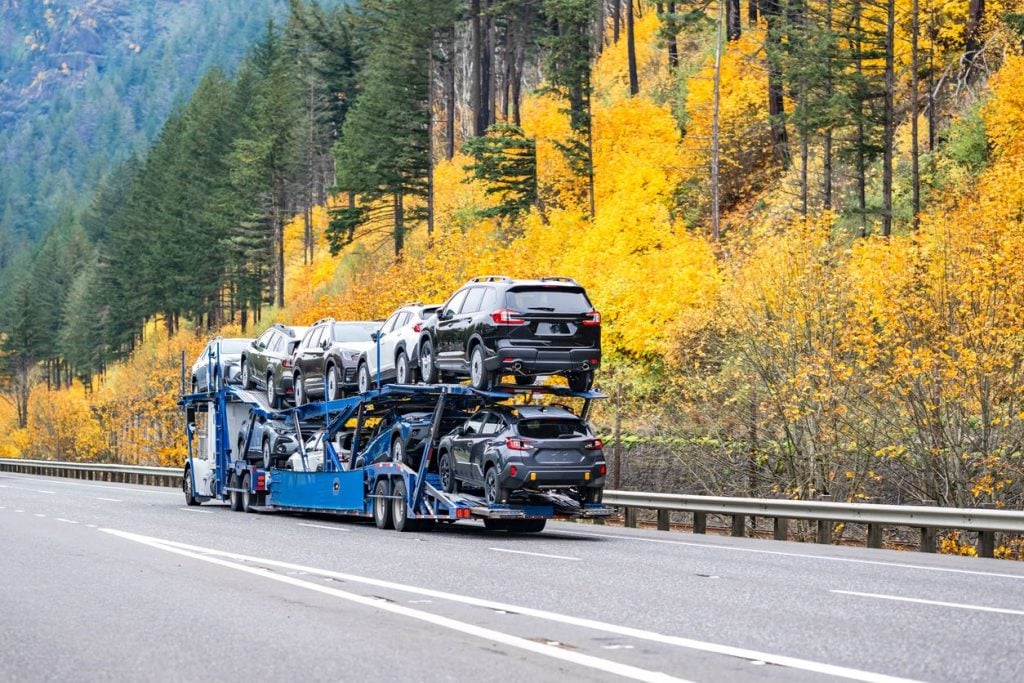
Door-to-door means the carrier collects and delivers at addresses you specify, and it is included in our quotes. It does not mean the truck parks at your curb. A car carrier is around 75 feet long and cannot legally enter many residential streets, gated communities, or dense urban blocks, so expect an agreed meeting point nearby when access is tight.
Tell the coordinator what both locations are actually like, narrow street, gated entry, apartment complex, steep driveway. Identifying a constraint in advance is free; discovering it with a driver waiting is not.
Multiple Vehicles on One Move
If you are relocating a household with two cars, ship them together. Carriers price the second vehicle on the same truck more favorably than two separate arrangements, and both arrive at once rather than days apart. The same logic applies to a small fleet: consolidating onto one carrier is almost always cheaper than sequential single shipments.
Get a Quote
Call Ship A Car, Inc. at (866) 821-4555, or price your interstate move with the instant calculator.