Buying a Car at Auction: What to Know Before You Bid
Auction cars are cheaper than dealership cars for one reason: the risk sits with the buyer. There is no test drive worth the name, usually no warranty, no negotiation and no returning it on Monday. What you get in exchange is a price that reflects that.
That trade is a good one if you go in prepared and a bad one if you do not. Here is what to understand before you register.
Not All Auctions Are Open to You
Five broad types, and which ones you can use matters before anything else.
Public auctions are open to anyone. Inventory is mixed: trade ins, repossessions, fleet retirements and consignments.
Dealer only auctions require a dealer license, and they carry the bulk of the volume in the country. This is where most used dealership inventory comes from, and the general public cannot bid without a license or a broker who has one.
Salvage and insurance auctions sell vehicles written off by insurers. Some are lightly damaged; many are not. Title status here is the entire question and it is covered below.
Government and fleet auctions sell retired municipal, utility and agency vehicles. Often well maintained with documented service history, frequently high mileage, and rarely exciting.
Classic and collector auctions operate differently again, with catalogs, published estimates and viewing days, and they are the one category where inspection access is usually generous.
Understand the Title Before the Price
This decides what the car is worth and whether it can be insured and registered normally.
A clean title means the vehicle has not been declared a total loss. A salvage title means an insurer wrote it off, and in most states a salvage vehicle cannot be legally driven until it is repaired and passes a state inspection. A rebuilt or reconstructed title is what a salvage vehicle receives after that inspection, and it stays on the record permanently.
A rebuilt title car is worth substantially less than the equivalent clean title car, is harder to insure for full coverage, and is harder to sell later. None of that makes it a bad buy at the right price. It makes it a bad buy at a clean title price.

The Fees Are Not Small
The hammer price is not what you pay. Budget for a buyer premium, which is a percentage of the sale price and is often tiered so it is proportionally higher on cheaper cars. Add documentation fees, gate or loading fees at some auctions, internet bidding fees on online platforms, and applicable taxes.
Storage is the one that catches people. Most auctions allow a small number of free days after the sale and then charge daily. On a cheap car those fees can become a meaningful fraction of what you paid within two weeks.
Work out your true all in cost before you set a maximum bid, because the difference between the hammer price and the total is regularly ten percent or more.
Inspection Is Limited, So Use What There Is
Most auctions have a preview period. Use it, and take someone who knows cars if you do not.
You generally cannot drive the car. You can usually look underneath, check panel gaps and paint texture for signs of repair, look for corrosion, check fluids, inspect tire wear for alignment problems, and start the engine where permitted. Rust, mismatched paint, uneven panel gaps and a strong smell of damp inside are the things that cost the most to put right.
Read the run list and the condition report. Auctions use grading systems and announcement codes, and a car announced with a specific defect is disclosed rather than hidden. Learn what the codes mean at the auction you are attending, because they vary.
Where a vehicle history report is available, pull it. It will not catch everything, but it will catch a great deal.
Set a Maximum and Do Not Move It
Auctions are designed to produce competitive bidding, and the atmosphere works. Decide your maximum all in figure before the car crosses the block, write it down, and treat it as fixed.
The specific trap is the two bidder duel, where the price passes what either party intended to pay because neither wants to lose. There is always another car. Walking away from one is free; overpaying is not.
Online auctions add a different trap, which is the ease of bidding from a sofa on a car nobody has physically inspected. The discipline needs to be stronger there, not weaker.
Payment and Collection Run on Deadlines
Auctions require payment quickly, usually within a day or two, and accepted methods are limited. Confirm what is accepted before you bid rather than after you win.

Collection has its own clock. You will need a gate pass or release document, and the auction will specify who is authorized to collect. If someone else is picking the car up for you, including a transport driver, the authorization needs to be in place in advance or the driver will be turned away.
Getting the Car Home
Arrange this when you win rather than when the title arrives, for the storage fee reason above.
Give the transport company the auction name and location, your buyer number, the lot or stock number and the release requirements. Say clearly whether the car runs and drives, since a non runner needs a winch equipped truck, and salvage auction purchases frequently do not run.
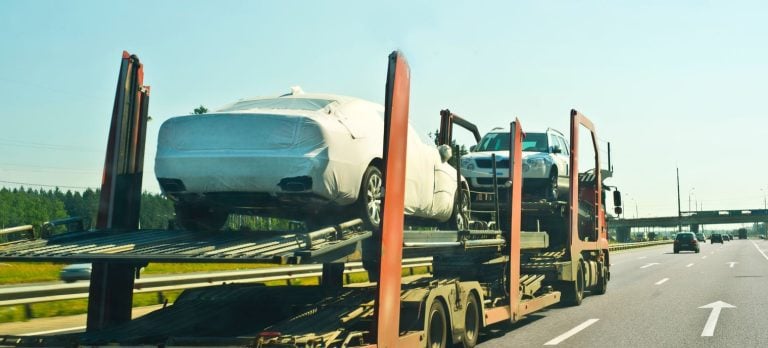
Driving an unknown auction car home over a long distance is the other risk worth naming. You have no service history, no idea when the brakes were last done and no warranty. Shipping removes that, and on a long trip it usually costs less than fuel, lodging and time once you total them honestly. Our page on shipping a car from an auction covers the process end to end, and salvage auction transport covers what changes when the car does not run.
Common Questions
Can anyone bid at a car auction? At public, salvage, government and collector auctions, generally yes. Dealer only auctions require a license.
What is the real cost above the hammer price? Buyer premium, documentation and gate fees, online bidding fees, taxes and storage after the free days.
Is a rebuilt title car worth buying? At the right price, sometimes. It is worth much less than a clean title car and is harder to insure and resell.
Can I test drive before bidding? Almost never. Preview inspection is usually limited to looking and, at some auctions, starting the engine.
How soon do I need to collect? Within a few days at most auctions, after which daily storage fees begin. Arrange transport as soon as you win.
Get a Quote
Call Ship A Car, Inc. at (866) 821-4555 with the auction location, your delivery zip code and whether the car runs, or price the move with the instant calculator.