Car Will Not Start: How to Jump Start a Vehicle Correctly
Most jump starts go wrong in the same two ways: the cables are connected in the wrong order, or the car did not need a jump at all. Both are avoidable in about a minute of checking. What follows is the correct sequence, the checks worth doing first, and the specific situations where you should not attempt it.
First, Work Out Whether It Is the Battery
The symptom tells you a lot, and jumping a car with a different problem wastes time.
Nothing at all, no lights, no click, no dash: usually a completely dead battery or a bad connection at the terminals. Check the terminals first, because a loose or corroded clamp looks exactly like a dead battery.
Rapid clicking when you turn the key: classic low battery. There is enough power for the starter solenoid but not enough to turn the engine. This is the case a jump start fixes.
One solid click and nothing: more likely the starter than the battery, and a jump start will not help.
Engine turns over normally but will not fire: the battery is fine. The problem is fuel, spark or something else, and jumping it achieves nothing.
Dash lights bright, then everything dies when you turn the key: a battery with a failed cell. It may take a jump and then fail again immediately.
What You Need
Either a set of jumper cables and a second vehicle, or a portable lithium jump pack.
Jump packs have become genuinely good and they remove the second vehicle, the parking geometry and most of the ways to get the sequence wrong. If you keep one thing in the trunk, make it that.
If using cables, check the gauge. Thin cables sold as an emergency set frequently cannot carry enough current to start anything larger than a small engine, and they get hot trying.
The Correct Sequence
Order matters, and the reason is the last connection: it will spark, and you want that spark away from the battery.

Park the vehicles close but not touching. Turn both off, put both in park or neutral, and set the parking brakes. Turn off headlights, climate control and anything else drawing power in the dead car.
Then, in this order:
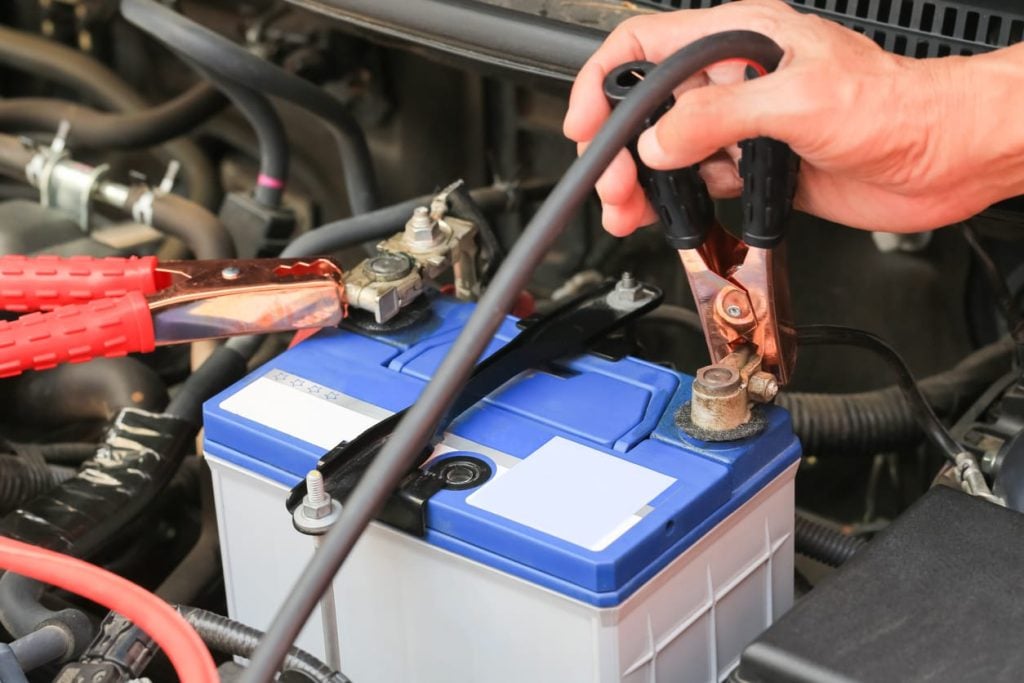
1. Red clamp to the positive terminal of the dead battery.
2. Red clamp at the other end to the positive terminal of the good battery.
3. Black clamp to the negative terminal of the good battery.
4. Black clamp to an unpainted metal ground point on the dead car’s engine block or chassis, not to the negative battery terminal.
That fourth step is the one people get wrong. Connecting to the dead battery’s negative terminal puts the final spark directly beside a battery that may be venting hydrogen. A ground point several inches away is the whole point.
Start the donor car and let it run for a few minutes. Then try the dead car. If it does not start within about five seconds of cranking, stop and wait a minute rather than cranking continuously.
Disconnect in exactly the reverse order: black from the ground point, black from the good battery, red from the good battery, red from the dead battery. Do not let the clamps touch each other or any metal while any of them is still connected.
Then drive the revived car for at least twenty minutes, or leave it running. A jump start does not charge a battery; the alternator does, and that takes time.
When Not to Attempt It
Four situations where the right move is to stop.
A visibly damaged, leaking, swollen or frozen battery. Do not jump it. A frozen battery in particular can rupture.
Any smell of rotten eggs, which is sulfur from a battery that is off-gassing. Walk away and call for help.
You cannot identify the terminals or the correct ground point. Many modern cars have a remote positive post under a plastic cover and a designated ground stud, precisely because the battery is somewhere inaccessible. Check the owner’s manual rather than guessing.
Hybrid and electric vehicles. These have a conventional 12 volt battery that can be jumped, but the procedure and the connection points are specific, and the high voltage system must not be involved. Follow the manufacturer’s instructions exactly, and never use a hybrid or EV as the donor vehicle unless the manual says you can.
If It Will Not Start, or Keeps Dying
A car that needs jumping twice in a week has a problem that a jump start is not fixing.
The usual causes are a battery at the end of its life, typically three to five years, a failing alternator that is not recharging it, or a parasitic drain from something staying awake when the car is off. Any auto parts store can test the battery and the charging system, usually free.
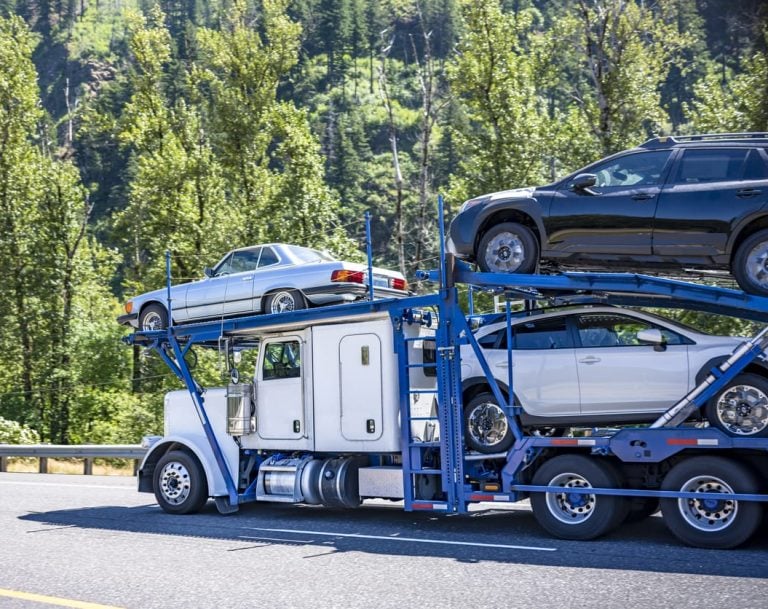
This matters for anyone about to ship a vehicle. A car that will not start reliably needs to be declared as inoperable when you book, because it requires a winch and a carrier equipped for it. Discovering it at pickup is the most expensive kind of surprise, and it is the single most common reason a scheduled collection fails.
Common Questions
Which cable goes on last? The black clamp to an unpainted ground point on the dead car, away from the battery, because that connection sparks.
Can I connect black to the dead battery’s negative terminal? You should not. It puts the spark next to a battery that may be venting hydrogen.
How long should I drive afterward? At least twenty minutes. The jump only starts the car; the alternator does the charging.
My car clicks once and does nothing. Will a jump help? Probably not. A single solid click points at the starter rather than the battery.
What if I am shipping the car? Declare it inoperable when you book if it does not start reliably. It needs a winch and a carrier equipped for it.
Get a Quote
Call Ship A Car, Inc. at (866) 821-4555 with both zip codes and whether the vehicle runs and drives, or request an estimate for the move through the quote calculator.