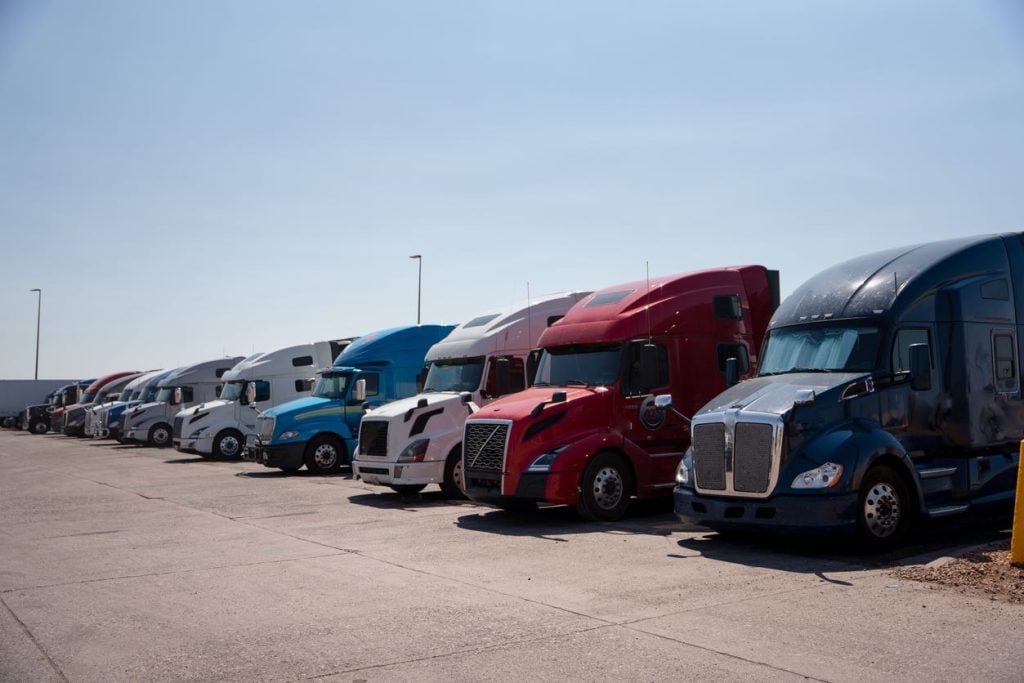
The Taxes on a Truck, and How They Reach Your Shipping Quote
A working Class 8 truck carries a stack of federal and state taxes that most people never see, and all of them are inside the price you are quoted to move a car. Fuel tax, a heavy vehicle use tax, an excise tax on the equipment itself and a patchwork of state registration and mileage fees. None appear as a line item; all of them are in the number.
Here is what a carrier actually pays, and why some of it moves your quote and some of it does not.

Fuel Tax Is the One You Feel
Diesel carries a federal excise tax plus a state tax that varies substantially, and the state component is the reason the same fuel costs meaningfully different amounts across a state line.
Interstate carriers do not simply pay tax where they fill up. Under a fuel tax agreement between the states and Canadian provinces, a carrier reports the miles driven in each jurisdiction and settles the difference quarterly, so tax is ultimately paid to the state where the fuel was burned rather than where it was bought. Buying cheap fuel in a low tax state does not avoid the tax owed for miles run in a high tax one.
For a customer, the effect is that route composition matters slightly beyond distance. A route weighted toward high fuel tax states carries a marginally higher underlying cost than the same mileage elsewhere.
The Heavy Vehicle Use Tax
A federal annual tax on trucks at or above 55,000 pounds gross weight, scaled by weight and capped at the top end. It is filed once a year and is a real fixed cost for every carrier running heavy equipment.
Because it is annual and per vehicle rather than per mile, it behaves like insurance or a payment: it has to be recovered across whatever miles the truck runs that year. A truck that runs hard spreads it thin. A truck sitting idle still owes it.
The Excise Tax on Buying the Truck
This is the one that surprises people. A federal excise tax applies to the purchase of new heavy trucks and trailers, calculated as a percentage of the sale price, and on modern equipment it adds a substantial sum to an already large purchase.

It has a side effect worth understanding, because it shapes the fleet on the road. Adding a large percentage to the price of new equipment discourages replacement, which keeps older trucks working longer than they otherwise would. Older trucks cost more to maintain and are less fuel efficient, and both of those land back in operating cost.
Whichever way you think that policy should go, the practical consequence is that a good deal of the car hauling fleet is older than it would be if new equipment were cheaper.
State Registration and Mileage Fees
On top of the federal items, a carrier registers its trucks through an apportioned system that divides registration fees among the states it operates in, based on distance traveled in each. A few states add their own weight-distance or highway use taxes on heavy vehicles, filed separately.
For a national carrier this is a meaningful administrative burden as well as a cost, and it is one of the quiet reasons very small operations sometimes stay regional: the compliance overhead of running everywhere is real even before the tax is paid.
What Does Not Move Your Quote
Two things worth separating, because they get conflated with the above.
The mileage deduction rate published for business travel is an income tax provision for people deducting the cost of using a personal vehicle. It has nothing to do with commercial trucking costs and does not affect freight pricing, despite appearing in a great deal of trucking commentary.
And per diem allowances for drivers are a tax treatment of subsistence expenses, not a new cost. They change a driver’s take-home position and a carrier’s paperwork, not the underlying economics of the load.
One more that is easy to miss: tolls. On the eastern corridors in particular, a truck running a route weekly accumulates real toll cost, and unlike fuel there is no reclaim mechanism. It is simply part of what the lane costs to serve, which is one reason identical mileage prices differently east and west.
How Any of This Reaches You
Indirectly, and in aggregate. A carrier decides whether a load is worth taking by whether the rate covers fuel, driver pay, equipment, insurance, maintenance and its share of the fixed annual costs, taxes included. That total is what sets the floor under any route.

That is why a quote materially below everything else on the same route is usually not a better deal. It is a number that has not been tested against a carrier’s actual cost base, and the pattern that follows is silence and then a revision. The full picture of what a truck costs to run is in our page on what it costs to run a truck, and how the market prices day to day in the spot market and the contract market.
Common Questions
Do I pay any of these taxes? Not directly. They are carrier costs recovered inside the rate you are quoted.
Does a fuel surcharge appear on my bill? On vehicle transport, fuel is normally built into the quoted price rather than added separately.
Why does the same distance cost different amounts? Route composition, including which states the miles fall in, alongside timing, access and vehicle size.
What is the excise tax on trucks? A federal tax on the purchase of new heavy trucks and trailers, which discourages replacement and keeps older equipment running.
Does the IRS mileage rate affect shipping prices? No. That is an income tax provision for personal vehicle use, unrelated to freight costs.
Get a Quote
Call Ship A Car, Inc. at (866) 821-4555 with both zip codes and your date range, or request an estimate for the move through the quote calculator.