Buying Heavy Equipment at Auction
Equipment auctions have become the default way used machinery changes hands in this country, and the single most common mistake buyers make is treating transport as an afterthought. A winning bid starts a clock: most auction houses charge storage after a few days, and a machine that cannot be moved becomes a machine accruing fees. Arrange the haul before you bid, not after you win.

Why Auctions Took Over
Three changes pushed the used equipment market toward auction and away from private sale.
Online bidding removed geography. A buyer in Georgia can bid on a machine in Idaho without traveling, which widened every auction’s pool of buyers and made consignment more attractive to sellers.
Fleet turnover accelerated. Rental companies and large contractors now cycle equipment on shorter schedules, and auction is the fastest way to liquidate at scale.
And price discovery improved. With enough bidders, an auction produces a defensible market price, which matters to lenders, insurers and accountants in a way a negotiated private sale does not.
The practical consequence for a buyer is that inventory is national rather than local, and the machine you want is frequently several states away.
Cost the Transport Before You Bid
This is the discipline that separates buyers who do well from buyers who do not.
Get the make, model, and the manufacturer’s shipping weight and dimensions from the lot listing. Then get a transport quote to your yard before the auction closes, so the number is part of your bidding limit rather than a surprise afterward.
On a machine near legal limits, transport can be a substantial fraction of the purchase price, and it varies enormously by distance and by whether permits and escorts are needed. Two identical machines at two auctions can have very different landed costs.
Ask the auction house about load out specifically: whether they have equipment to load, what hours load out runs, and how many days you have before storage begins. Some yards load for you and some expect you to arrange it entirely.
Online, Onsite and Timed Sales Are Not the Same
Three formats dominate and each changes how you should plan the collection.
A live onsite auction sells a whole yard in a day, and load out is usually organized and time limited: crews and equipment are on hand for a short window, then the yard wants everything gone. That is the easiest case to transport out of, provided you have booked.
An online timed sale closes lots individually over hours or days, frequently at a dealer or a permanent facility. Load out tends to be by appointment and more flexible, but the free storage period is often shorter and enforced.
Retiring fleet and bankruptcy sales are the third and most variable. The equipment may be scattered across several sites, and a single invoice can mean three separate collections in three states. Read the lot locations carefully before bidding, because “one auction” does not always mean one place.
In every format the question to ask is the same and it is rarely on the website: who loads, using what, on which days, and how long before storage starts.
Know What You Are Buying
Auction machinery is sold as is, where is, and that phrase carries real weight.
Inspect in person or pay somebody to. Photographs do not show hydraulic weeps, undercarriage wear, cracked welds or a smoking engine. Where an inspection service is available, it is cheap relative to the risk.
Check the hour meter against the machine’s condition, and treat a large mismatch as a question rather than a bargain. Get the serial number and verify there is no lien attached, because a machine with an outstanding finance interest is a problem you inherit.
And read the buyer’s premium and fee schedule before bidding. The hammer price is not the price, and premiums plus documentation and load out fees can add a meaningful percentage.
Whether It Runs Changes Everything
Transport for a running machine and a dead one are different jobs.
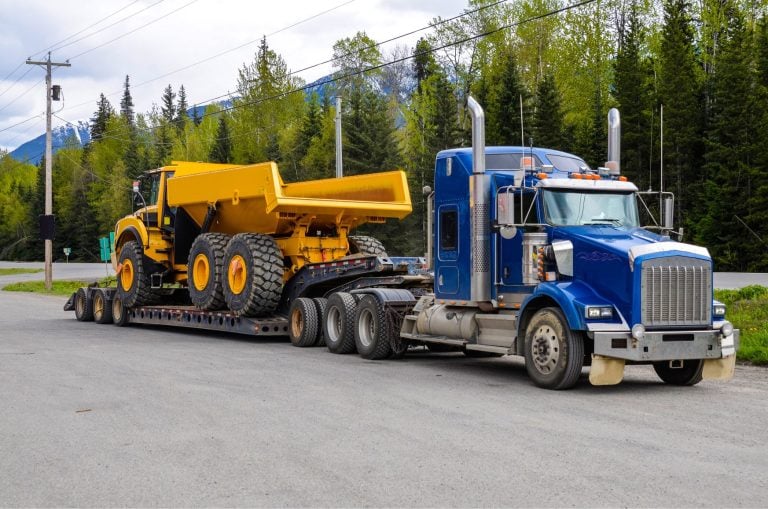
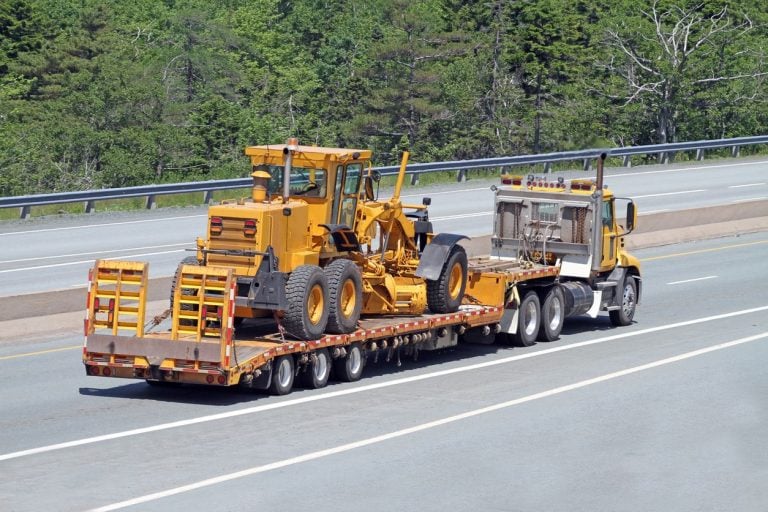
A machine that starts and drives can be loaded under its own power onto a lowboy with ramps, which is fast and comparatively cheap. A machine that does not run needs winching, and on something heavy that means specific equipment and more time.
Auction listings frequently describe a machine as running without anybody having tried it recently. Ask directly, and if the answer is uncertain, quote the transport as non running so the price you plan around is the realistic one.
Measure Before You Assume
Legal limits are 8 feet 6 inches wide and 13 feet 6 inches high measured from the road in most states, with 80,000 pounds gross for the combination.
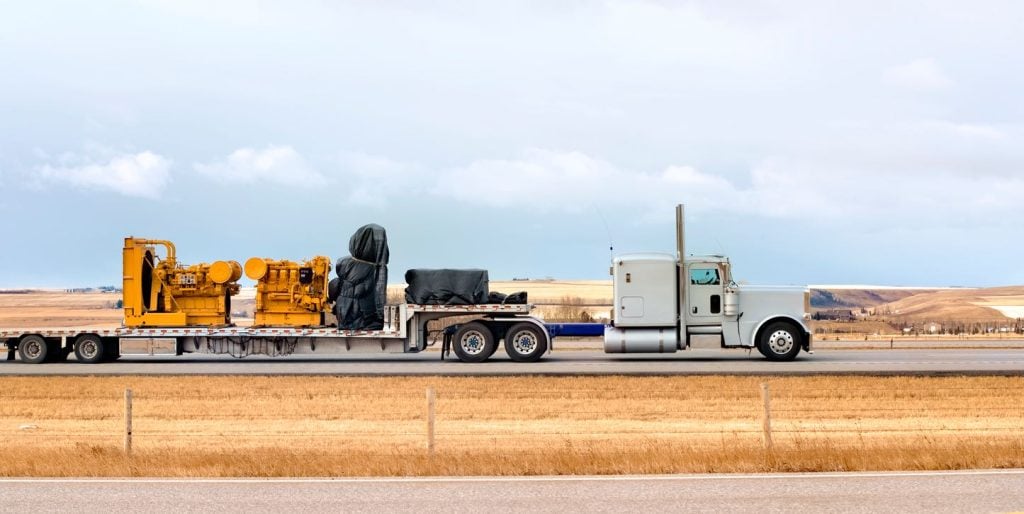
Height is the one that catches buyers, because a trailer deck sits around 5 feet off the road before the machine is on it. A 9 foot machine is at the limit on a flatbed and needs a step deck or a lowboy.

Reducing the envelope is frequently possible and worth doing: removing a counterweight, lowering or removing a boom, taking off a bucket or swapping wide pads can bring a load under a threshold and save a permit and an escort. Our guide to heavy equipment transportation covers the preparation in depth.
Load Out Day
Have the paperwork ready: proof of payment, a release from the auction house, and identification. Yards will not release a machine without them and a driver waiting is a driver charging.
Photograph the machine in daylight from every side before it loads, including the undercarriage, the glass and the hour meter. Used equipment arrives with wear as standard, and without your own record any damage argument at the destination becomes unwinnable.
Get existing damage described specifically on the bill of lading rather than as “used condition, general wear”, which is the phrase that defeats claims.
Common Questions
When should I arrange transport? Before you bid. Storage fees usually start within a few days of the sale, and the haul cost belongs inside your bidding limit.
Does the auction house load the machine? Sometimes. Ask about load out equipment, hours and free storage days before the sale rather than after.
What if the machine does not run? It needs winching and specific equipment, and it costs more. Confirm rather than assuming, and quote it as non running if unsure.
Do I need a permit? If the machine exceeds 8 feet 6 inches wide, 13 feet 6 inches high from the road or 80,000 pounds gross, yes, for every state on the route.
Is the hammer price the price? No. Buyer’s premium, documentation and load out fees all sit on top, and then transport.
Get a Quote
Call Ship A Car, Inc. at (866) 452-3657 before you bid, with the make, model, weight and dimensions from the lot listing and the auction yard location, or request a quote through the specialized transport calculator.