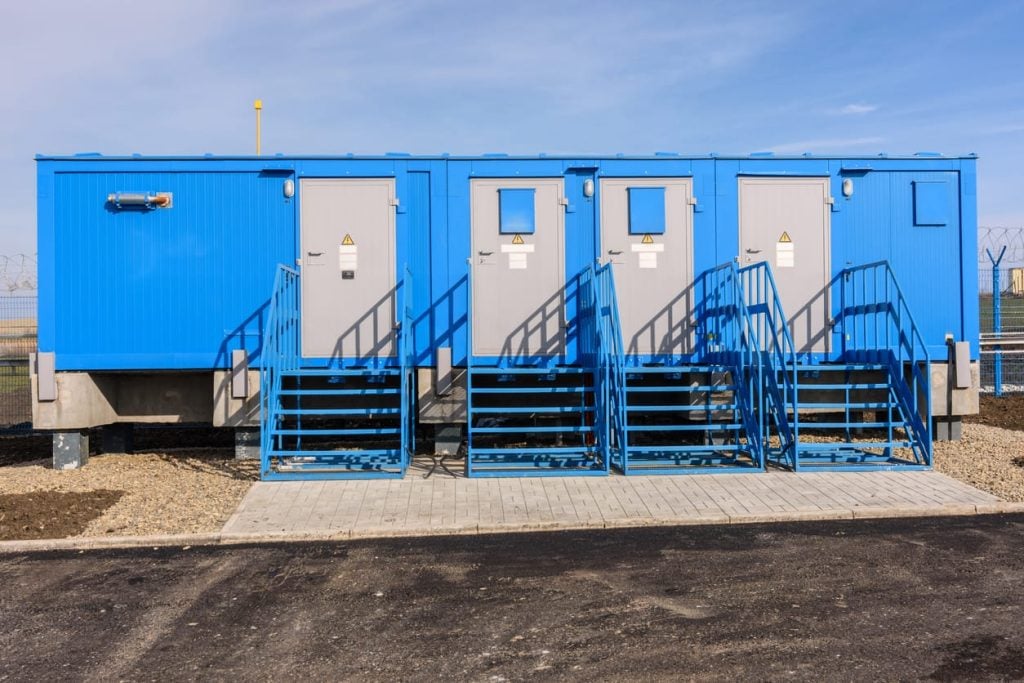
Transporting a Shipping Container Office
The dimension that catches people is height, and it catches them because of the deck rather than the container. A standard container is 8 feet 6 inches tall and a high cube is 9 feet 6 inches. Put a high cube on an ordinary flatbed, whose deck already sits around 5 feet off the road, and the loaded height lands near 14 feet 6 inches, comfortably over the 13 feet 6 inch legal limit. The container was never the problem. The trailer choice is.
Know Which Container You Have
Two numbers decide almost everything: the length and whether it is a high cube.
A 20 foot container is 8 feet wide and 8 feet 6 inches tall. A 40 foot is the same cross section, twice the length. A high cube of either length adds a foot of height, and that foot is what pushes the load into permit territory once it is on a deck.
The fix is a lower deck. A step deck buys roughly a foot over a flatbed and a lowboy buys more again, which is usually enough to bring a high cube back inside legal height. Measure and tell us before anyone quotes, because the trailer type is the largest single line in the price.
Weight Depends on the Fit Out, Not the Box
An empty 20 foot container is roughly 5,000 pounds and an empty 40 foot around 8,000. Those are easy numbers.
A finished office is not. Insulation, wall panels, flooring, windows, a door, electrical fit out, HVAC, plumbing, desks and shelving all add up, and a converted unit can weigh several times the empty shell. Give us the actual weight if you know it, or a realistic description of the build if you do not, because guessing low here changes the axle configuration and therefore the permit.
Lifting Is the Part to Arrange First
This is where these moves go wrong, and it is a site question rather than a trucking one.
A container has to get onto the trailer and off again. That means either a crane or forklift capable of the weight at both ends, or a tilt bed or roll off trailer that can load the container itself. If you have lifting equipment at the origin but nothing at the destination, the move stops halfway.
Confirm both ends before booking. Confirm the ground can take the equipment too, because a crane on soft ground is its own problem, and confirm there is room to maneuver a truck of around 70 feet plus whatever is lifting.
Secure the Inside
A container office is not a moving truck, and treating it like one causes most of the damage we see on these loads.
Everything inside must be fixed down or removed. Desks, chairs, filing cabinets, monitors and tools all become projectiles over road miles, and they damage the interior finish far more effectively than the road damages the shell. Disconnect and drain any plumbing, isolate the electrics, and secure or remove HVAC units that were not installed for transit.
Lock and latch the doors, and if the unit has windows, consider boarding them. Then photograph the interior as well as the exterior before it moves, because interior damage is otherwise impossible to attribute.
Permits and Route
Over 8 feet 6 inches wide, 13 feet 6 inches high or 80,000 pounds gross needs a state permit for every state on the route, issued for a defined path and period.
A container at 8 feet wide is inside legal width, so height and weight are the usual triggers. Permitted loads generally travel in daylight on weekdays, and metro areas restrict movement during peak hours, so a permitted container move is scheduled around travel windows rather than departing whenever the crane finishes.
What to Tell Us When You Book
The length, whether it is a high cube, the actual weight including the fit out, and what lifting equipment exists at each end. Then the access at both sites: surface, gradient, overhead obstructions and how much room a truck has to turn.
Those answers produce a firm price. Without them any quote is a guess that will move once the details arrive.
Common Questions
Why does a high cube need a special trailer? Its extra foot of height, plus a standard deck, exceeds the 13 feet 6 inch limit. A step deck or lowboy brings it back inside.
Do I need a crane at both ends? Yes, unless a tilt bed or roll off trailer is used. A missing lift at the destination stops the move.
How heavy is it? Empty, roughly 5,000 pounds for a 20 foot and 8,000 for a 40 foot. A fitted out office is considerably more.
Can the contents stay inside? Only if fixed down. Loose furniture and equipment damage the interior in transit.
Is it a permit load? If it exceeds 13 feet 6 inches loaded, or 80,000 pounds gross, yes, for every state on the route.
Get a Quote
Call Ship A Car, Inc. at (866) 452-3657 for heavy haul and specialized freight, with the container length, whether it is a high cube, the weight and the lifting arrangements at both ends.