Choosing a Work Truck, and Getting It Home
Two decisions, in order. First, spec the truck to the work: payload and towing capacity you will actually use, bed configuration, cab size for the crew, and the drivetrain your job sites require. Second, get it to you, which for work trucks usually means shipping, because the right configuration is rarely at the nearest dealer and driving it home puts hours on a warranty clock before the truck has earned anything.
Payload and Towing Are Different Numbers
They are routinely confused and it is expensive. Payload is what the truck carries, everything in the bed and cab including passengers and equipment. Towing capacity is what it pulls behind. A truck rated to tow 12,000 pounds may have a payload under 2,000, and hitching a heavy trailer consumes payload through tongue weight.

Work out both numbers for your actual worst case: full crew, tools, materials, and a loaded trailer. Then buy above it. Trucks operated permanently at their limit wear brakes, suspension, and drivetrain fast.
Class Matters More Than Badge
Half-ton trucks (F-150, Silverado 1500, Ram 1500) suit light trades, service calls, and crews carrying tools rather than materials. Three-quarter and one-ton trucks (F-250/350, 2500/3500) step up substantially in payload and towing and are the practical floor for construction, towing equipment trailers, or carrying dense materials. Above that, medium-duty chassis cabs enter commercial licensing territory.
The threshold worth watching is 26,001 pounds gross vehicle weight rating, above which drivers need a commercial license. Many businesses deliberately spec just under it.
Gas or Diesel
Diesel makes sense for sustained heavy towing, high annual mileage, and businesses that keep trucks a long time; the torque and longevity are real. It costs more upfront, more to service, and the emissions systems on modern diesels dislike short trips and extended idling.
Gasoline suits lighter duty cycles, lower annual mileage, and stop-start local work. For a truck doing 12,000 mostly local miles a year, the diesel premium rarely pays back.
Bed, Cab, and Upfit
Regular cab maximizes bed length; crew cab carries the crew and shortens it. Decide which constraint actually binds. Then account for upfitting, service bodies, ladder racks, toolboxes, and liners all add weight that comes directly out of payload, and can add height that matters when the truck ships.
Shipping the Truck
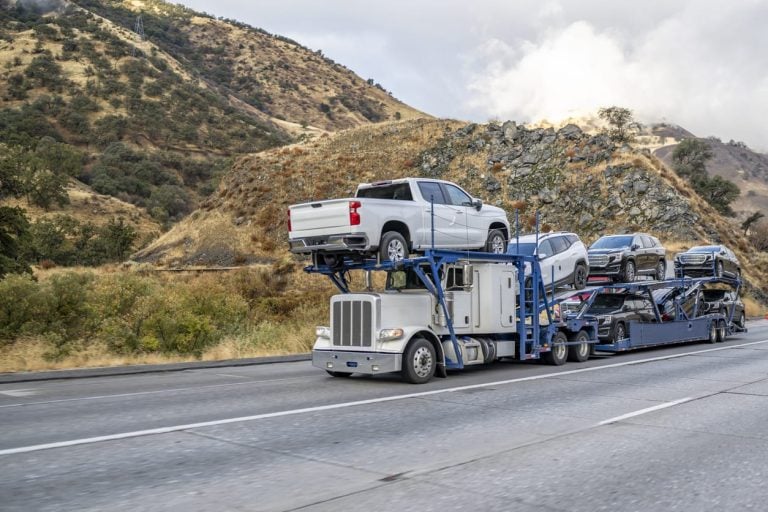
Work trucks ship on standard open carriers, priced above a sedan because of length and weight. Three things determine whether your quote holds:
- Give exact dimensions. Not the base model figures. A lifted truck, one with a ladder rack, service body, or oversized tires, measures differently and may need a different carrier.
- State the weight accurately, including any permanently installed equipment.
- Say whether it runs. A non-running truck needs a winch, typically adding $100 to $250. Those are planning estimates. Our own book since 2023 covers 137 non-running vehicles, where the middle half ran $750 to $1,500.
Dually pickups and anything with a raised roof or utility body are the common cases where a standard car carrier will not work and the shipment needs a flatbed or step deck instead. Flagging that at quote stage avoids a repriced booking.
Buying Out of State
Work truck configurations are allocated regionally, so the exact spec you need is frequently several states away. Shipping keeps the odometer at delivery mileage and keeps your crew working rather than sending someone on a two-day round trip. Coordinate the dealership release the same way you would for any commercial pickup: a named contact, confirmed payment, and a collection window they know about.
Common Questions
How much does shipping a pickup cost? Above sedan rates because of size and weight. Open transport broadly runs $0.84 to $2.05 per mile depending on distance; a full-size truck sits toward the upper end of the band for its lane.
Can I ship tools or equipment in the bed or cab? Generally no. Federal rules restrict cargo in shipped vehicles and personal items are not covered by carrier insurance. Empty the truck before pickup.
What about a truck with a plow mount or crane? Tell the coordinator. Attached equipment changes dimensions, weight distribution, and sometimes the trailer type required.
Is enclosed transport worth it for a work truck? Rarely. Open is standard and appropriate. Enclosed makes sense for a show truck or a fully restored classic, not a working vehicle.
Get a Quote
Call Ship A Car, Inc. at (866) 821-4555 with the truck’s dimensions and weight, or start with the instant calculator.