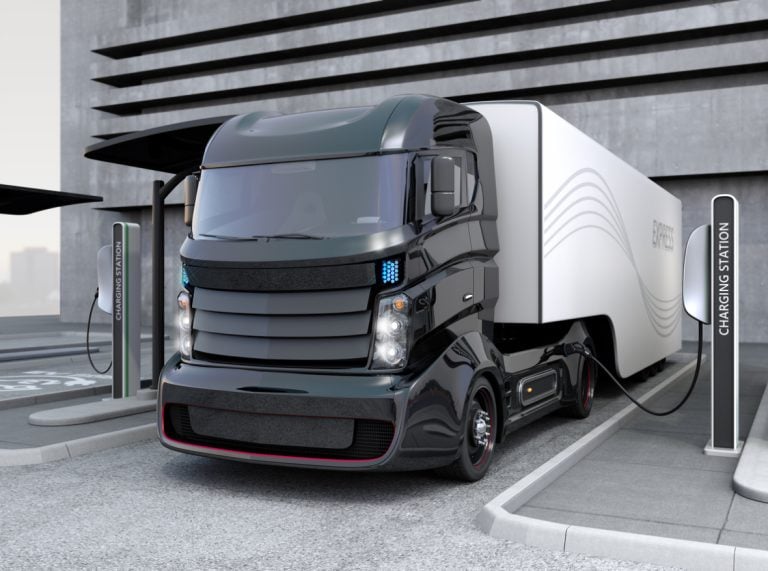
Automatic Emergency Braking on Heavy Trucks
A loaded tractor-trailer at highway speed needs roughly the length of a football field to stop, and the single largest component of that distance is the time before the brakes are applied at all. Automatic emergency braking attacks exactly that gap. It is the most consequential safety technology to reach heavy trucks in a generation, and it has changed how the truck carrying your vehicle behaves.
Why Stopping Distance Is the Problem
The physics are unforgiving. A tractor-trailer at 80,000 pounds carries roughly twenty times the kinetic energy of a car at the same speed, and it dissipates that through brakes that are already working hard.
Total stopping distance is perception time, plus reaction time, plus the mechanical braking distance. At 65 miles an hour a vehicle covers around 95 feet per second, so a second and a half of human perception and reaction is close to 150 feet before the brakes do anything.
An automatic system reacts in a fraction of that. It does not brake harder than a good driver; it starts sooner, and on a heavy vehicle starting sooner is worth more than braking harder.
How the Systems Work
Most combine radar with a forward-facing camera, and increasingly with additional sensors.
Radar measures distance and closing speed to objects ahead reliably in rain, fog and darkness. The camera classifies what the radar has found: a stopped vehicle, a pedestrian, a lane marking, a sign. Fusing both reduces false positives, which matters enormously, because a heavy truck braking hard for a phantom obstacle creates its own danger.
The response is graduated. First a warning to the driver. Then partial braking if the driver does not act. Then full braking if a collision becomes unavoidable. In most systems the driver can override throughout, because the system assists rather than replaces.
Related functions usually ship alongside: adaptive cruise control that maintains a following distance, lane departure warning, electronic stability control that intervenes on rollover and jackknife risk, and blind spot monitoring.
What It Does Not Do
Worth stating clearly, because the marketing frequently is not.
These are collision mitigation systems more than collision avoidance systems. In many real crashes the system reduces the impact speed substantially rather than preventing contact, and that is still a very large benefit: injury severity scales steeply with speed.
They are also weakest exactly where you might hope for most: sudden cut-ins at close range, stationary objects in unusual positions, and severe weather that degrades sensor performance. A driver is still driving the truck.
Why It Has Taken So Long
Three reasons, and they are worth knowing because they explain the uneven fleet.
Cost. The systems add to the price of a tractor, and the trucking industry is dominated by very small operations for whom that is a real barrier.
Fleet age. Trucks last a long time. Even if every new tractor sold today had the technology, it would take many years for the working fleet to turn over.
Driver acceptance. Early systems produced false activations, and a heavy truck braking unexpectedly is genuinely alarming. That history left skepticism that later, better systems have had to overcome.
Federal rulemaking on requiring these systems for heavy vehicles has been proposed and revised over several years. Confirm the current position with the National Highway Traffic Safety Administration rather than relying on any summary.
The Data Behind the Claims
Safety technology attracts optimistic marketing, so it is worth separating what has been measured from what is asserted.
Studies of forward collision warning and automatic braking on heavy trucks have consistently found meaningful reductions in rear-end crash involvement, with the largest effects on the most severe categories. Research from the Insurance Institute for Highway Safety and from federal programs has pointed the same direction: fewer rear-end crashes, and lower impact speeds in the ones that still occur.
What the numbers do not support is the idea that these systems make a truck safe to follow closely or that they compensate for fatigue. The gains are real and they are incremental. A system that reduces rear-end crashes substantially still leaves the other crash types untouched, and those include rollovers, jackknifes and lane departure events where different technologies do the work.
That is the honest framing: this is one of several systems that together have made heavy trucks measurably safer over the past decade, not a solution to truck crashes.
What Drivers Say About Them
Adoption is not purely a purchasing decision, and driver experience shapes how well a system actually performs.
The common complaints are false activations in construction zones, on curves where a roadside object reads as an obstacle, and in heavy traffic where cut-ins are constant. A driver who does not trust the system drives around it, following further back than necessary or disabling optional functions where that is permitted.
Newer generations have reduced false positives substantially, and fleets that train drivers on what the system will and will not do get better outcomes than fleets that simply install it. Technology plus training beats technology alone, which is a pattern that holds across most of the safety equipment in this industry.
What It Means for Your Vehicle
Mostly good, and one thing worth understanding.

The benefit is straightforward: rear-end collisions are among the most common serious truck crashes, and your vehicle is cargo on a trailer that is considerably safer when the truck ahead of it stops properly.
The thing to understand is that a carrier running newer, better equipped tractors is generally also the carrier with a better maintenance program and a better safety record, because those things come from the same decision to invest. When you compare an unusually cheap quote against a normal one, part of what the difference buys is equipment.
You can see some of this in the record. A carrier’s inspection and crash history is public, and it is the best available proxy for how it operates. Our guide to what roadside inspections tell you covers how to read it.
Common Questions
How far does a loaded truck take to stop? Roughly the length of a football field at highway speed, and much of that is before the brakes are applied.
How does automatic braking help? It reacts in a fraction of human perception and reaction time. On a heavy vehicle, starting sooner matters more than braking harder.
Does it prevent crashes entirely? Frequently it reduces impact speed rather than avoiding contact. That is still a large reduction in injury severity.
Do all trucks have it? No. Trucks last a long time and the working fleet turns over slowly, so equipped and unequipped tractors run side by side.
Does it matter when I choose a carrier? Indirectly. Carriers investing in newer equipment generally also have better maintenance and safety records.
Get a Quote
Call Ship A Car, Inc. at (866) 821-4555 with both zip codes and your date range, or request an estimate for the move through the quote calculator.