Heavy Equipment Shipping in New York
New York is two completely different heavy haul problems sharing one state name, and quoting the wrong one is how schedules fall apart. Upstate is ordinary permitted trucking across open highway. The city is a routing puzzle where parkways are closed to commercial traffic, bridge and tunnel clearances decide the path, and the load may only move in a narrow overnight window. Say which New York you mean at the first conversation and everything downstream gets easier.

The City Is a Routing Problem
Commercial vehicles are barred from the parkways entirely, which removes many of the obvious routes before you start. What remains is a smaller network of truck routes with their own clearances, and an oversize load has to be threaded through it.
Bridge and tunnel restrictions then narrow it further. Height limits vary by crossing, some crossings bar certain loads outright, and the authorities that run them are not always the same body issuing your state permit. A load that is routine on I-90 across the state can need a bespoke route and its own approvals to reach a site in Brooklyn.
Movement is also time restricted. Permitted loads in the metro generally travel outside peak hours and frequently overnight, so the schedule is set by when the load may legally move rather than by when the machine is ready.
Upstate Is Ordinary Heavy Haul
Away from the metro, New York behaves like any other state with good highway infrastructure. The Thruway and the interstates carry permitted loads routinely, and carrier supply is solid.
The variable upstate is winter. Snow through the Southern Tier and the lake effect belt off Ontario and Erie closes routes and stops permitted movement, which travels in daylight and stops for weather. A February move across the north should carry more schedule slack than the mileage suggests.
Site Access Decides More Than the Trailer
On a city job the constraint is usually the site, not the road.
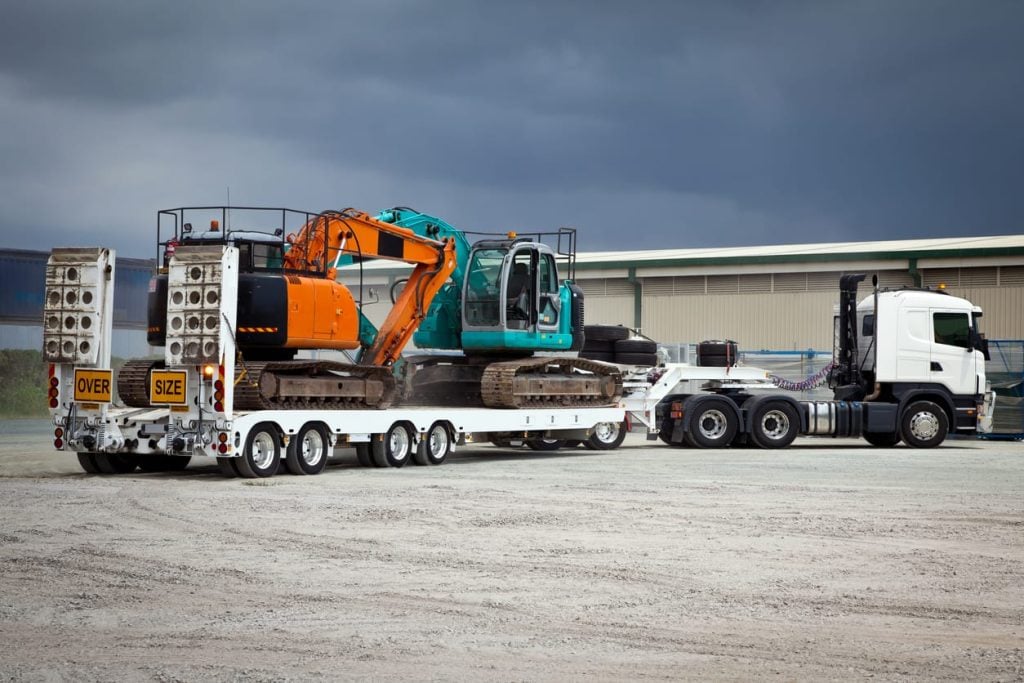
A truck of around 70 feet needs somewhere to stop, room to turn and space to unload, and a Manhattan or Brooklyn site frequently has none of the three. Deliveries may need a street permit, a specific time window, or a staging point outside the borough with a shorter final leg.
Tell us what the site actually looks like: the street width, whether there is a yard or only a curb, overhead wires, and whether lifting equipment is available. Those answers change the equipment we send far more than the machine’s weight does.
Permit Thresholds
The federal baseline applies. Over 8 feet 6 inches wide, 13 feet 6 inches high, or 80,000 pounds gross needs a state permit for every state on the route, for a defined path and period, with escorts past roughly 12 feet wide.
Height is measured from the road, not from the deck, and it is the figure people most often get wrong. A step deck buys about a foot over a flatbed and a lowboy buys more again.
What Moves the Price
Three things, roughly in order. Dimensions decide the trailer and whether a permit is needed at all, and that single choice is the largest line in most quotes. Escorts, once width requires them, add a vehicle and a driver for every mile of the permitted route.
Then the destination. A yard upstate off the Thruway prices like ordinary heavy haul. A restricted city site with a night window, a street permit and a staging leg is a different job at a different number, even for the same machine over a shorter distance.
Reducing the machine is the lever you control. Taking off a bucket, a counterweight or a set of wide pads can drop a load out of permit territory entirely, and twenty minutes in the yard routinely saves more than the labor costs.
Measure the Machine, Not the Brochure
Manufacturer specifications describe a standard configuration and yours may not be standard.
Counterweights, buckets, blades and ripper shanks change the envelope and most come off. Wide track pads fitted for soft ground push a machine past legal width on their own. Fluid filled tires add weight nobody can see from outside.
Give the working weight with attachments, the measured width and height, and whether it drives and steers under its own power.
Preparing the Machine
Most damage happens during loading. Lower and pin the attachments, remove or fold the stack, beacon and mirrors, reduce fuel to the level the carrier asks for, and lock the brakes.
Clean off mud and stones, since falling debris is a serious matter and mud hides existing damage. Photograph every side including glass, lights and undercarriage, then walk it with the driver so the condition is on the paperwork before it moves.
Common Questions
Can a machine be delivered into Manhattan? Often yes, but by a specific truck route with its own clearances and usually in a restricted time window.
Why can the truck not use the parkway? Parkways are closed to commercial vehicles, so the route has to use designated truck routes instead.
Is upstate different? Considerably. Upstate is ordinary permitted trucking; winter weather is the main variable.
What decides the trailer? Measured height, width and weight, and whether the machine drives on under its own power.
Do I need lifting equipment on site? If the machine does not drive on and off, yes, and it needs arranging at both ends.
Get a Quote
Call Ship A Car, Inc. at (866) 452-3657 for heavy haul and specialized freight, with the machine’s measured dimensions, weight and the exact site address.