Used equipment is where most contractors get their best value and their worst surprises, and the difference is almost always what was checked before the money moved. A machine with 6,000 hours and a complete service record is a better buy than one with 3,000 and none. Hours are the headline. History is the substance. And the transport home, which most buyers price last, is the line item that turns a good deal into an average one when it is left out of the arithmetic.
The Case For Buying Used
Depreciation is the whole argument. The first owner absorbs the steep part of the curve, and a machine that has done three seasons of work costs a fraction of the new price while doing the same job. Availability is the second argument: a new machine may be months out from the factory, and a used one is on a yard today. Proven models are the third. A machine that has been in the market for years has known failure points, known parts availability and mechanics who have seen every fault it develops.
The Case Against
You inherit the previous owner’s maintenance, or the lack of it. Warranty is short or gone. Emissions tiers and telematics vary by model year, and a machine that is legal on one job may not be on another with stricter requirements. Financing terms are less generous than on new equipment. None of these is disqualifying. All of them belong in the price.
What to Inspect Beyond Hours
- Service records. Complete records raise the value of a machine more than a low hour meter does.
- Undercarriage. On tracked machines, measure wear on the chains, sprockets, rollers and idlers. Undercarriage can be a third of the machine’s value.
- Hydraulics. Cylinders for leaks and scoring, hoses for cracking, and every function for drift under load.
- Structure. Frames, booms and sticks for repaired cracks, and pins and bushings for play.
- Fluids. Oil analysis if you can get it. Milky oil and dark coolant tell their own story.
- Everything under power. Cold start, full travel on every function, a drive in both directions, and a check of the brakes and steering.
Auction, Dealer or Private Sale
Auctions offer the sharpest prices and the least information, with tight removal deadlines and storage fees that start when they end. Dealers offer inspected, sometimes warrantied machines at a price that reflects it, from yards with loading equipment and normal business hours. Private sellers and contractors offer machines straight off a project, often with the operator available and the history known, from job sites and farms where access has to be checked before a carrier is sent. Each route changes the transport plan as much as it changes the price.
Budgeting the Trip Home
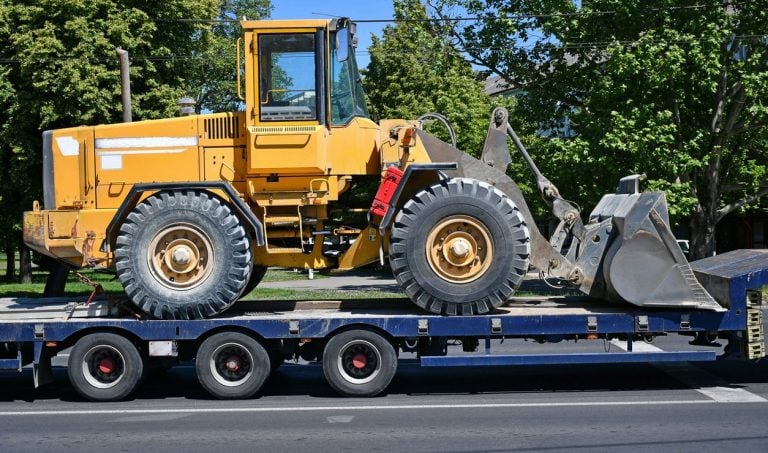
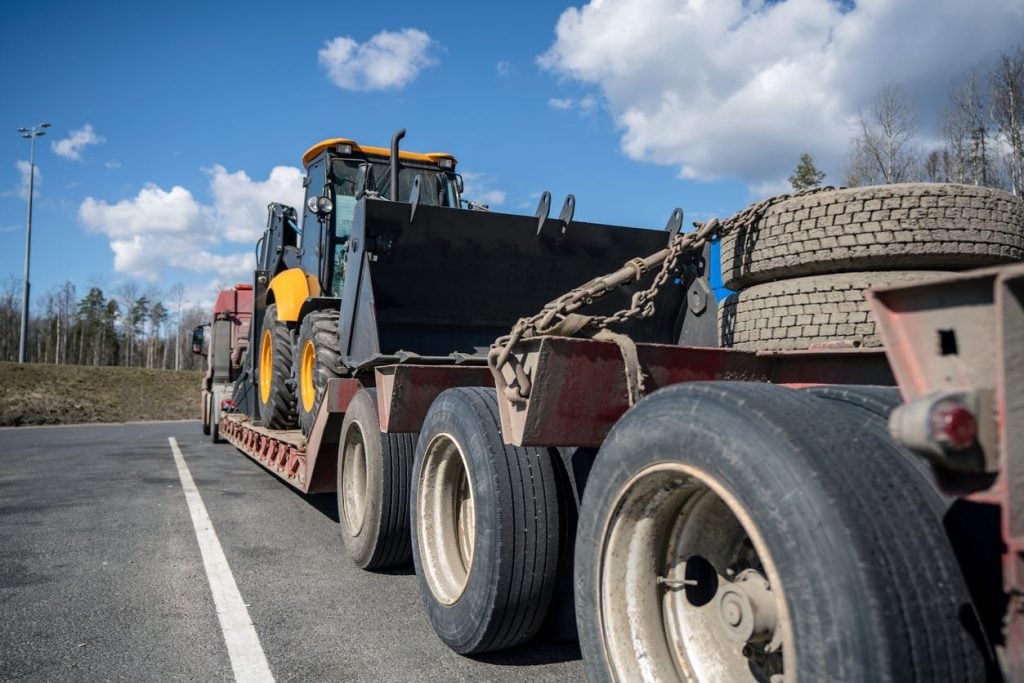
The delivered price is the real price, and the transport is knowable before you buy. Four things set it: the machine’s operating weight, its transport dimensions with attachments in travel position, whether it drives under its own power, and what loading equipment exists at each end. A compact machine rides on a standard flatbed within legal dimensions. A full-size excavator, dozer or grader needs a removable gooseneck or lowboy and, above legal width or height, permits for every state on the route. Loads above roughly 14 feet wide take escort vehicles as well, and permit and escort costs are itemized in the quote before you confirm.
Our equipment shipping page covers carrier types and securement, and the oversized and heavy equipment page covers permits, escorts and superloads. Get the number with the listing open, and treat it as part of the bid.
Timing the Move to the Purchase
At auction, the clock starts when the hammer falls. Have the coordinator ready to dispatch the day the invoice clears, and give the yard’s release requirements to the coordinator in advance so the driver arrives with the paperwork the gate will ask for. From a dealer, the move can wait for your schedule. From a private seller, confirm the site can take a lowboy and agree where the machine will be staged for loading. In every case, confirm whether the machine runs, because a dead machine needs a winch or a crane and the load is planned around that from the start.
Preparing the Machine to Ship
- Clean the undercarriage and body. Caked material adds weight and height and can trigger agricultural checks at some state lines.
- Transport positions. Blades angled back and lowered, buckets curled to the stick, booms down, outriggers and stabilizers retracted, articulation pinned.
- Attachments. Declare what is fitted. Removable items ride secured on the same trailer or travel separately if they push a dimension over the limit.
- Photograph everything from every side before the carrier arrives. The bill of lading condition report is the record.
- Fluids and battery. Fix active leaks and confirm a charge, so the machine drives off at your yard rather than being dragged.
Common Questions
Can I get a transport quote before I bid? Yes. The model and hours are in the listing and the manufacturer publishes weight and dimensions. Bid on the delivered number.
How long does the move take? A legal-dimension machine usually ships within a week or two of booking. Permitted loads add the permit time, and superloads add route surveys and escorts.
Who arranges permits and escorts? We do, for every state on the route, itemized before you confirm.
What if the machine does not run? Declare it at booking. A winch, or a crane where the weight requires one, is part of the plan rather than a surprise at the yard.
Is the carrier’s insurance enough? Cargo insurance covers the load in transit up to a per-load limit. Ask the coordinator for the figure and compare it with the purchase price.
Get a Quote
Equipment goes through the freight desk. Put the machine, its weight and dimensions, the yard and your site into the freight quote calculator, or call (866) 452-3657 with the listing in front of you and a coordinator will give you the delivered number before you bid. No deposit is taken until a carrier is assigned to your order.