Transporting a Shipping Container Pool
A container pool is a shipping container full of water fittings, and the number that decides the whole job is whether it ships empty. It does, always. Water weighs a little over eight pounds per gallon, so even a modest container pool full would add tens of thousands of pounds and put the load far beyond any legal weight. Drained, it is simply a 20 or 40 foot container with a liner and some plumbing, and it moves like any other container.
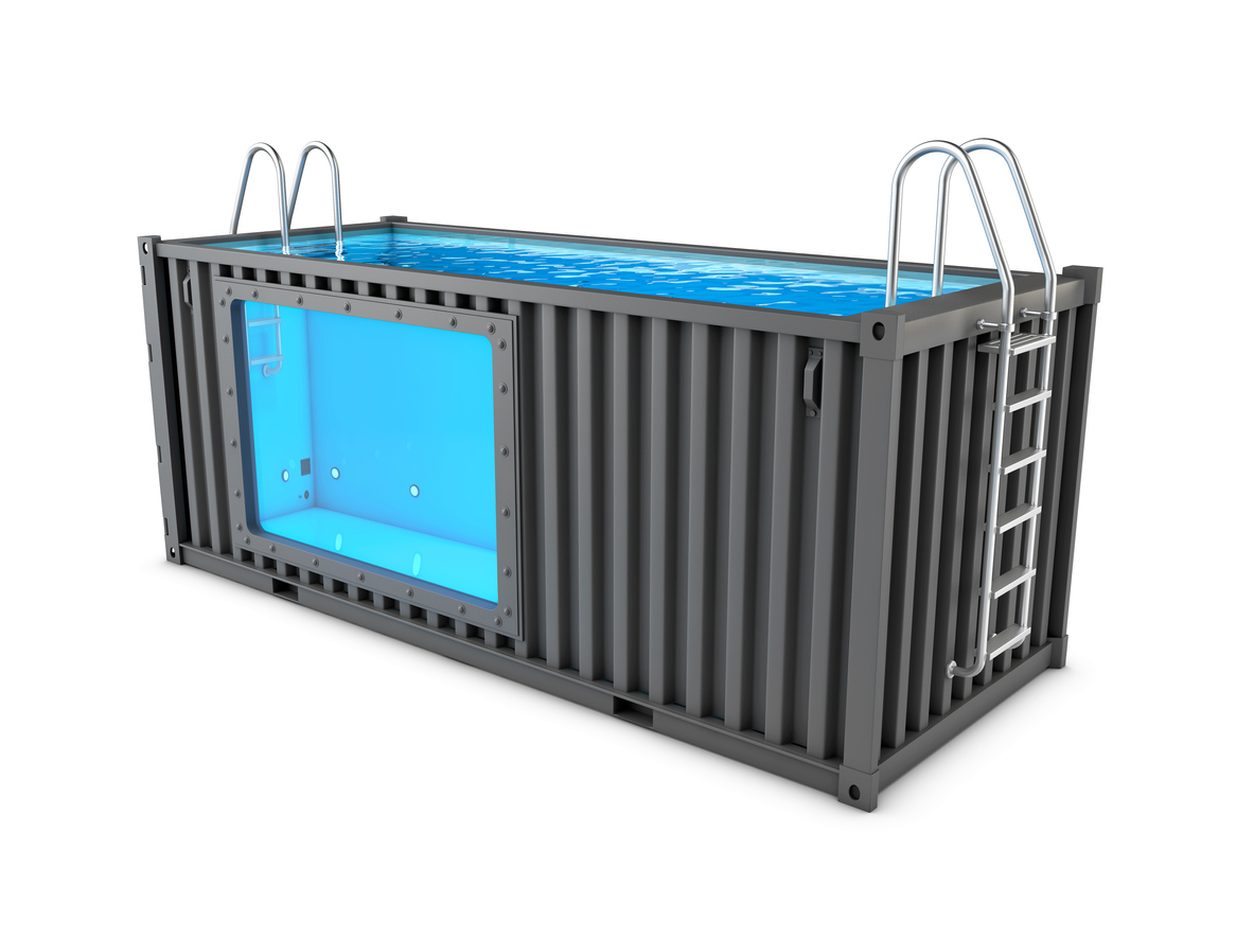
Empty, and Properly Drained
Draining is not just about the main body of water. Pumps, filters, heaters and the lines between them all hold water, and a hard freeze in transit will split whatever is left in them.
Blow out or drain the plumbing rather than simply opening a valve, and disconnect and separately pack the pump and filter if they are removable. If the unit ships in winter across northern states, treat this as the main preparation task rather than a detail.
Anything still holding water is also weight the load plan did not account for, which matters at a scale house.
Height Is the Other Constraint
The container itself is 8 feet 6 inches tall, or 9 feet 6 inches for a high cube. A standard flatbed deck sits around 5 feet off the road, so a high cube on a flatbed lands near 14 feet 6 inches and exceeds the 13 feet 6 inch legal limit.
A step deck buys roughly a foot and a lowboy buys more, which is usually enough to bring it back inside legal height. But a pool conversion often adds to the top as well: decking, railings, a fitted cover, steps or a mounted equipment housing. Measure to the highest point of the finished unit, not to the top of the container.
Anything that unbolts and can travel separately is worth removing, because a foot of height frequently decides whether you need a permit at all.
Lifting at Both Ends
This is the step people arrange last and should arrange first.
The unit has to get onto the trailer and off again, which means a crane or a suitable forklift at both the origin and the destination, or a tilt bed or roll off trailer that can load itself. Lifting equipment at one end only stops the move halfway.
A pool container also has known lifting points, and they are not always the original container corner castings once it has been cut and reinforced. Confirm where it can be lifted from before the crane arrives, because a unit slung from the wrong points can distort and a distorted pool no longer seals.
Site Access Decides the Equipment
The destination is usually a residential property, and that is a very different proposition from a commercial yard.
A truck of around 70 feet plus a crane needs room to get in, turn and set up, and the ground has to take the weight of the lifting equipment. Overhead power lines are a genuine constraint on a crane lift and need checking before the day, not on it.
Tell us the street width, the gradient, the surface, the overhead clearance and where the unit has to end up. Those answers determine what equipment we send, and getting them wrong means a wasted day.
Permits and Weight
Over 8 feet 6 inches wide, 13 feet 6 inches high or 80,000 pounds gross needs a state permit for every state on the route.
An empty 20 foot container is roughly 5,000 pounds and a 40 foot around 8,000, but a pool conversion adds structural reinforcement, a liner, decking and equipment, so the finished unit weighs considerably more than the shell. Give the actual weight from the manufacturer if you have it, because guessing low changes the axle configuration and therefore the permit.
Protect the Finish
The pool interior is the expensive part and it is exposed for the whole journey unless you cover it.
Fit the cover if the unit has one, or sheet it, and secure that covering properly so it cannot flap. Pad and secure anything inside that could move: steps, ladders, covers, equipment. Then photograph the interior surface, the seals and the exterior from every side before it is lifted, because a scratch in a liner is exactly the kind of damage that becomes impossible to attribute afterwards.
Common Questions
Can it ship with water in it? No. Water weight would put the load far beyond legal limits. It always ships drained.
Why does the plumbing need blowing out? Residual water in pumps and lines splits them if it freezes in transit.
Do I need a crane at both ends? Yes, unless a tilt bed or roll off trailer is used. Lifting at one end only stops the move.
Is it a permit load? If the finished height exceeds 13 feet 6 inches on the deck, or the weight exceeds 80,000 pounds gross, yes.
Can it be delivered to a back yard? Only if a crane can reach it. Access, ground conditions and overhead lines decide that.
Get a Quote
Call Ship A Car, Inc. at (866) 452-3657 with the container length, the finished height and weight, and the lifting arrangements at both ends.