Shipping Bricks and Concrete Blocks
Masonry is the one freight where you run out of weight long before you run out of space. A 48 foot flatbed has deck for far more brick than it can legally carry, so the load plan is built around the scale house rather than the trailer. That single fact drives everything else: how many trailers your order actually needs, how the load is secured, and why a delivery that looks like one truck on paper turns out to be two. The other half of the job is what happens at the site, because a flatbed of block with nothing to unload it is a stalled delivery.
You Hit the Weight Limit First
Federal gross weight is capped at 80,000 pounds without a permit, and once you subtract the tractor and trailer a standard flatbed is left with roughly 45,000 to 48,000 pounds of payload. Masonry reaches that quickly.
A banded cube of brick or a pallet of concrete block typically runs a couple of thousand pounds, so a legal load lands somewhere in the high teens of pallets rather than filling the deck. Order a quantity that sounds like one truckload and it may well be two.
This is why an accurate count matters more here than in most freight. Give the number of pallets or cubes and the weight per unit from the supplier, not an estimate of the total, and the load can be planned to arrive in the fewest legal trips.
Securement Is Regulated, Not Improvised
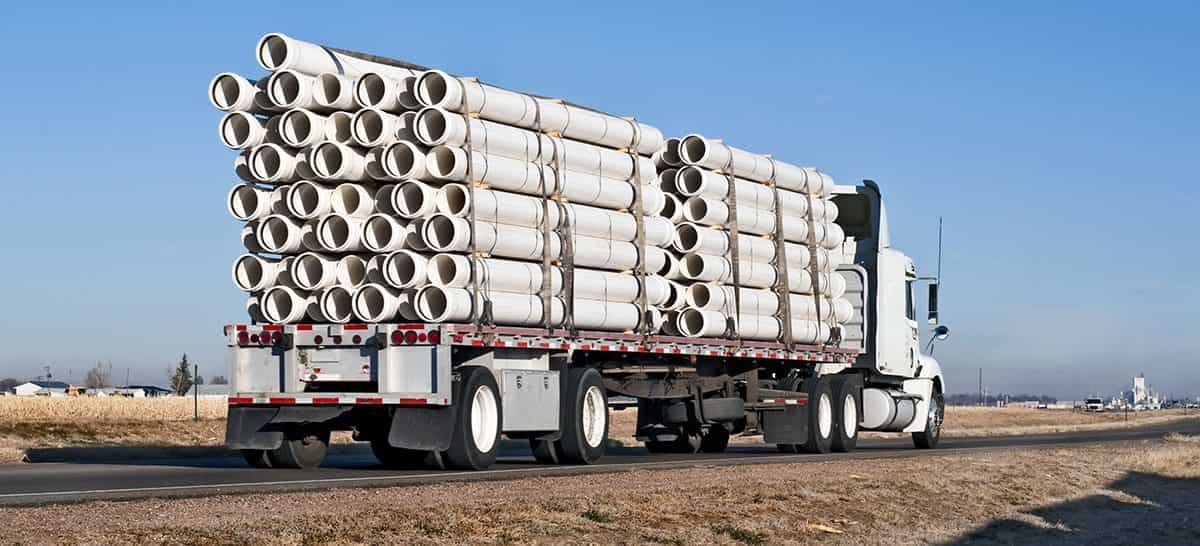
Masonry is covered by federal cargo securement rules, and for good reason: a shifting pallet of block is a serious hazard and a load that sheds on the interstate is a very serious one.
Expect banding at the pallet, then strapping across the load with edge protectors so the straps do not cut into the units, and blocking to stop movement fore and aft. Loads are checked and re-tensioned during the trip, because settling is normal in the first miles.
If your units are unbanded, damaged or irregular, say so before booking. Loose brick is a different job and some carriers will refuse it rather than take on the risk.
Tarping and Weather
Ask whether your load needs tarping, because it is a real cost and sometimes genuinely necessary.
Brick and block are not harmed by rain in the way finished goods are, but there are two practical issues. Wet masonry gains weight, which matters when you are already close to a legal limit. And moisture can contribute to efflorescence, the white salt bloom that appears on masonry, which is a cosmetic problem a builder will notice.
For most structural block it is optional. For face brick, architectural units or anything going straight into visible work, tarping is usually worth it.
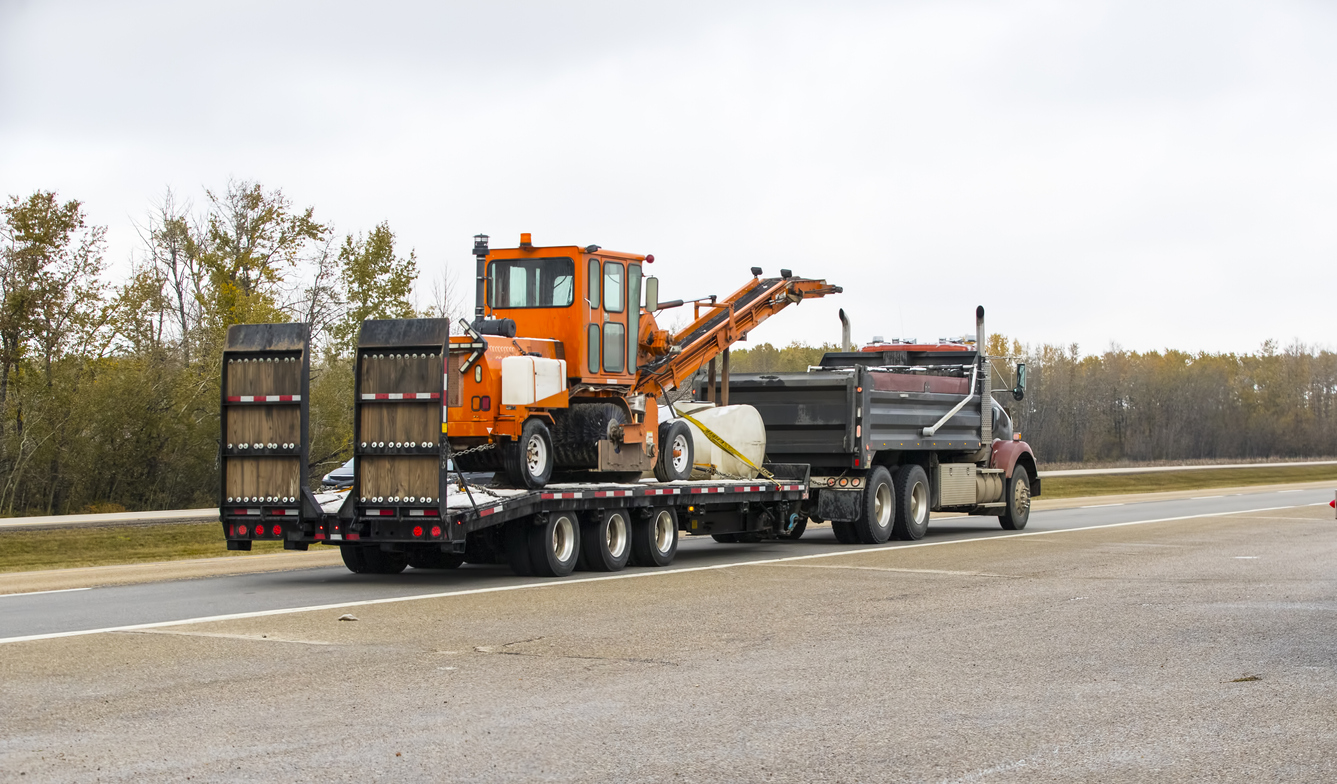
The Question Everyone Forgets: Who Unloads It
This causes more failed deliveries than anything else on this page, and it is entirely avoidable.
A flatbed driver carries straps and tarps, not a forklift. If the site has no loader, no telehandler and no crew, the truck cannot be unloaded and it either waits, at your cost, or leaves loaded.
Three normal solutions. The site provides equipment, which is standard on an active construction site. Or you book a truck mounted forklift, sometimes called a piggyback, which travels on the back of the trailer and unloads the load itself. Or delivery goes to a yard or supplier with equipment and you handle the last leg.
Decide this at booking. A piggyback costs more than a plain flatbed and far less than a stalled delivery.
Site Access Beyond the Equipment
Building sites are frequently the hardest part of the route. Tell us what the approach actually looks like: surface, gradient, turning room for a tractor and 48 foot trailer, overhead lines, and whether the ground will carry a fully loaded rig without sinking.
Timing matters too. Many sites and residential areas restrict heavy deliveries to certain hours, and in northern states spring thaw weight postings can close local roads to loaded trucks while the highway leg is unaffected.
What Drives the Price
Weight and distance first, then the extras. Tarping adds cost. A truck mounted forklift adds more. Multiple drops on one load add handling time. A site that cannot take a full size rig may need a smaller truck and therefore more trips.
Because masonry loads are weight limited rather than space limited, the most effective saving is usually consolidation: fewer, fuller, legal loads rather than several part loads on separate days.
Preparing the Load
Have the material banded and palletized before the truck arrives, with damaged units set aside rather than shipped. Confirm the weight per pallet in writing from the supplier. Make sure someone at the origin can load promptly, since detention time is chargeable.
Photograph the load once it is on the trailer and note the count on the paperwork. At delivery, check the count and the condition before signing, and record any breakage on the bill of lading while the driver is present.
Common Questions
How much brick fits on one truck? Weight decides, not space. A legal flatbed load is usually in the high teens of pallets, well short of filling the deck.
Do I need tarping? Optional for structural block, usually worth it for face brick or architectural units.
Who unloads at the site? You, unless you book a truck mounted forklift. A flatbed driver does not carry one.
Can you deliver to a residential address? Yes, with the access and unloading arranged in advance. Say what the approach looks like.
What do you need to quote? Pallet or cube count, weight per unit, both addresses, and what equipment is available to unload.
Get a Quote
Call Ship A Car, Inc. at (866) 452-3657 for freight and flatbed transport, with your pallet count, weight per unit and both site addresses.