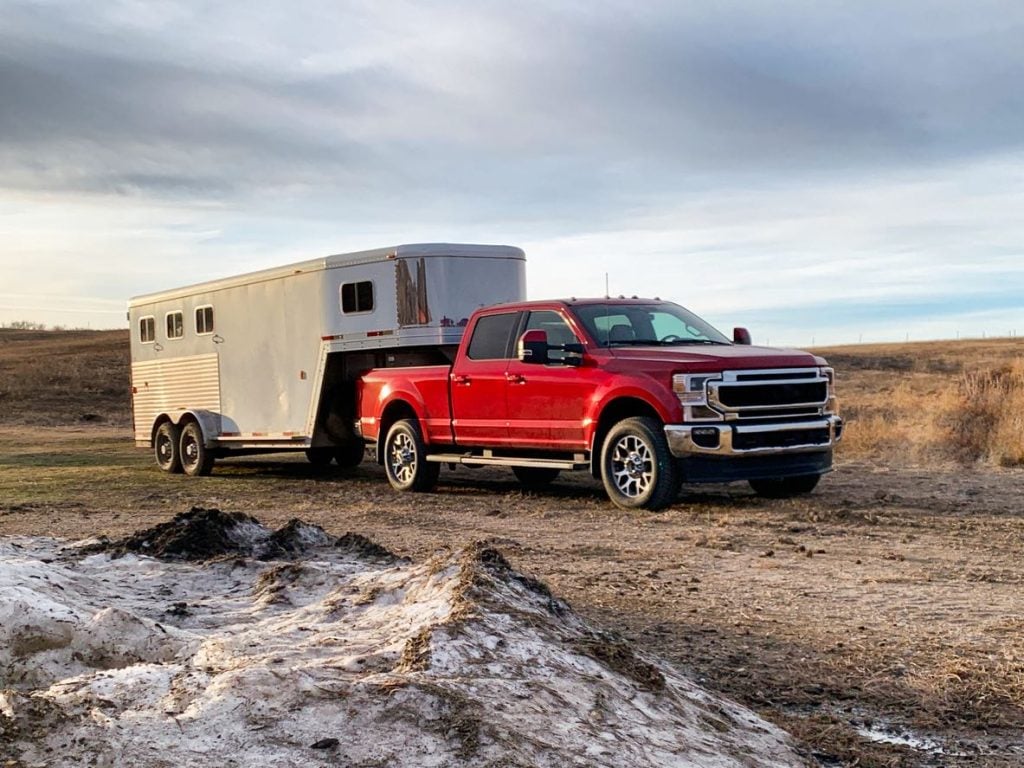
Pickup Truck Dimensions: What the Numbers Actually Mean
The four numbers that matter are payload, towing capacity, gross vehicle weight rating, and bed length, and three of them are routinely confused. Payload is what the truck carries. Towing is what it pulls. GVWR is the maximum the loaded truck may legally weigh, including itself. Bed length determines what fits without hanging over the tailgate. Get these right before buying, and give them accurately when shipping.
Pickup Classes and Capability Ranges
Those are ranges, not promises. Payload varies enormously within a single model depending on cab, bed, drivetrain, and options, and it is printed on the door jamb sticker of the specific truck. Always read that sticker rather than a brochure figure.

Payload Is Consumed Faster Than People Expect
Payload includes everything you add: passengers, tools, fuel, a bed cover, a toolbox, and critically the tongue weight of any trailer you tow, which is typically 10 to 15 percent of trailer weight. Hitch a 10,000 pound trailer and roughly 1,000 to 1,500 pounds comes straight out of payload before you have loaded anything in the bed.
This is why a truck advertised as towing 13,000 pounds may be unable to tow 13,000 pounds with four adults aboard. The limits interact.
The CDL Threshold
Once gross vehicle weight rating, or the combined rating of truck and trailer, exceeds 26,000 pounds, the driver generally needs a commercial license. This is why many businesses deliberately spec just under the line: crossing it changes hiring, insurance, and record-keeping fundamentally. Check the combined figure, not just the truck’s.
Bed Length and Cab Configuration
The trade is fixed: on a given wheelbase, a bigger cab means a shorter bed. Standard beds run roughly 5.5, 6.5 and 8 feet. An 8-foot bed carries full sheet goods flat; a 5.5-foot bed does not, and no bed extender fully solves that. Decide which constraint actually binds your work before choosing.
What Changes When You Ship a Pickup
Trucks price above sedans on the same lane because carriers sell deck space by length and weight. Three details determine whether your quote holds:
- Actual loaded height. A lift kit, oversized tires, a roof rack, or a service body can push the truck past what a standard car carrier can take, which means a flatbed or step deck instead.
- Dually rear axles. Wider rear track affects how the truck sits on a carrier and can restrict which trailers work.
- Attached equipment. Plow mounts, cranes, utility bodies and ladder racks all change dimensions and weight distribution. Mention them.
Measure the truck as it will actually ship, not as it left the factory. Giving base-model figures for a modified truck is the most common cause of a repriced booking.
Common Questions
Where do I find my truck’s real payload? The sticker on the driver’s door jamb states the specific vehicle’s payload and GVWR. It supersedes any published range.

Does a lifted truck cost more to ship? Usually yes, because added height can require a different trailer type and reduces how many vehicles the carrier can stack.
Can I leave tools in the bed or cab? No. Federal rules restrict cargo in shipped vehicles and personal items are not covered by carrier insurance. Empty it before pickup.
How much does shipping a full-size pickup cost? In our bookings between September 2025 and August 2026, open transport ran about $0.60 to $2.00 per mile depending on distance, with a full-size truck toward the upper end of the band for its lane. Coast to coast, the middle half of our car moves cost $1,450 to $1,800, and a full-size pickup usually lands toward the top of that range or above it.
Bed Volume vs Bed Capacity
Cubic feet and pounds are different constraints and trucks hit them at different times. A bed full of mulch reaches its weight limit long before it looks full. A bed full of insulation batts fills up while barely registering on payload. Know which of the two your typical load hits first, because it determines whether you need a longer bed or a heavier class.
Bed width between the wheel wells matters more than total width for anyone hauling sheet goods. Some trucks accommodate a 4-foot sheet flat between the arches and some do not, and the difference is not visible from a spec sheet.
Cab Configurations in Practice
Regular cab gives the longest bed on a given wheelbase and seats two or three. Extended or double cab adds rear seats that are usable for adults on short trips and fine for storage. Crew cab gives genuinely full rear seating and shortens the bed accordingly. For a work truck carrying a crew, the crew cab is not a luxury, it is the reason the truck exists; for a truck carrying materials, it costs you bed.
Diesel, Gas, and the Duty Cycle
Diesel earns its premium under sustained load: heavy towing, high annual mileage, and long ownership. The torque is real and the engines are long-lived. What diesels dislike is exactly the duty cycle many light-use owners give them, short trips and extended idling, which the emissions systems handle poorly.
For a truck doing modest local mileage without heavy towing, gasoline is usually the better economic choice even before you count the higher service costs on a diesel.
Get a Quote
Call Ship A Car, Inc. at (866) 821-4555 with the truck’s loaded dimensions and weight, or start with the quote calculator.