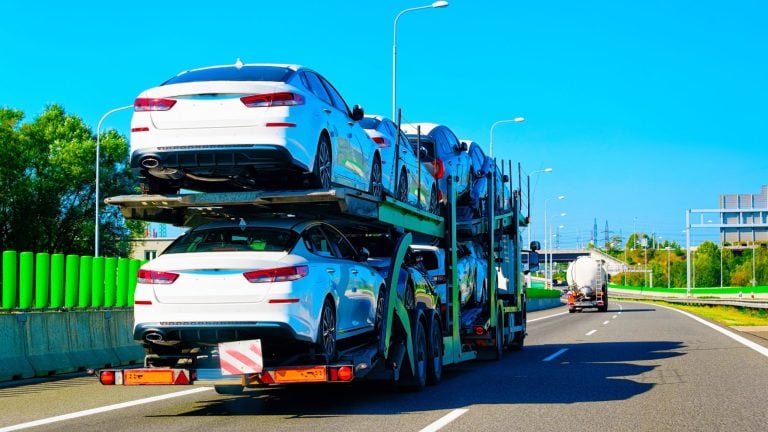
Auto Transport for Film and Television Production
A production has a call time. Auto transport gives you a window. Reconciling those two is the whole job. On a consumer move, a car arriving a day late is an inconvenience. On a shoot, it is a crew of forty standing around a location that costs money by the hour. Everything that makes production transport different from ordinary car shipping comes back to that one difference, and it is solvable, but not by booking the way you would book a household move.

A Call Time Is Not a Delivery Window
Standard auto transport works on ranges because carriers assemble loads. That model is cheap and it is fine when the date is soft. It is the wrong tool when a vehicle has to be on its marks at seven in the morning on a specific Tuesday.
Two things fix it. Book substantially earlier than you would otherwise, three to four weeks rather than one to two, so there is room to recover if anything slips. And for anything genuinely date critical, ask about dedicated or expedited transport, where the truck runs your vehicle rather than fitting it into a load. It costs more and it buys a date rather than a window, which is exactly what a production is paying for.
Build a buffer on top of that. Aim for delivery two days before the shoot, not the night before. Nobody has ever regretted a picture car arriving early.
Hero Cars, Doubles and Continuity
A picture car is not cargo, it is set dressing that has to match itself from shot to shot. That is why productions often move several identical vehicles, a hero car for close work and doubles for everything harder on the paint.
Continuity is what makes enclosed transport close to mandatory here. On an ordinary move, road film and a stone chip are cosmetic. On a shoot, they are a continuity problem that costs an afternoon to fix, and on a period vehicle the paint may not be simple to match at all. Enclosed transport adds 20 to 30 percent and removes that entire category of problem.
Tell the carrier what the vehicle is for. A driver who knows a car is going in front of a camera loads and secures it differently from one who thinks it is a used sedan.
Delivering to a Location With No Address
Sets are frequently somewhere a street address does not describe: a ranch, a stretch of closed highway, a desert flat, a back lot with a gate that is only staffed during shooting hours.
Give the carrier coordinates rather than a nearest town, and a name and mobile number for whoever controls the gate. Say what the last mile actually is, because a dirt access road that is fine for a crew van is not automatically fine for a 75 foot enclosed trailer, and the time to discover that is not at four in the morning.
Where access genuinely will not work, plan a staging point nearby and a short shuttle in. Location managers do this routinely and it is far better than a truck stuck at a cattle grid.
Picture Cars That Do Not Run
A good share of production vehicles are not roadworthy. Shells, gutted interiors, cars built for a single stunt, vehicles with the engine removed to fit a camera rig.
Quote these accurately and specifically. A car that does not start but rolls and steers is winched, which adds roughly $100 to $250. A shell that will not roll or steer is a different job with different equipment. Describe it plainly, because a driver arriving with the wrong trailer loses the day for both of you.
Volume, and the Trip Back
Productions rarely move one vehicle. Background cars, period vehicles, crew and support vehicles frequently travel together, and quoting them as one booking is cheaper per unit than separate ones.
Plan the wrap trip as well. Vehicles usually need to go back, often on short notice once the schedule firms up, and a carrier who already knows the location and the inventory can turn that around far faster than one starting cold.
Paperwork to Have Ready
Productions and studios usually require a certificate of insurance from the transport company before a vehicle moves, sometimes naming the production as additional insured. Ask for it early rather than the day before, since it has to come from the carrier’s insurer.
Confirm the cargo limit as well. Standard carrier cargo coverage is written for ordinary vehicles, and a rare or period picture car can exceed it. If the vehicle is genuinely valuable, establish the limit in writing before booking rather than assuming.
Common Questions
How far ahead should we book? Three to four weeks for a shoot date, and ask about dedicated transport for anything genuinely date critical.
Do picture cars need enclosed transport? Usually yes, because continuity makes cosmetic damage a scheduling problem rather than a blemish.
Can you deliver to a remote location? Yes, with coordinates and a gate contact. Tell us what the access road is really like.
Can you move a car that does not run? Yes. Say whether it rolls and steers, because a shell needs different equipment from a non starter.
Can you provide a certificate of insurance? Yes. Request it when booking so it is in hand before the vehicle moves.
Get a Quote
Call Ship A Car, Inc. at (866) 821-4555 with your shoot dates, locations and vehicle list, or price a single move with the instant calculator.