How to Ship a Car with a Modified Suspension or Lowered Ride Height
One measurement decides how a lowered car ships, and it is the distance from the ground to the lowest fixed point on the vehicle. Standard open trailer ramps sit at an angle that a factory car clears easily and a lowered car does not. Take that measurement before you call anybody, because it determines the equipment, the price and whether the car can be loaded at all without damage.

Measure the Ground Clearance Properly
Do this on level ground with the car at its normal ride height and normal tire pressures.
Find the lowest fixed point, which is usually not what people expect. On most lowered cars it is the front lip or splitter, the exhaust at its lowest hanger, the side skirts, or a subframe brace. Measure from the ground to that point and write the number down. Measure the front and the rear separately, because a lot of setups sit lower at the front.
As a working guide, anything above about 5 inches loads conventionally without much thought. Between roughly 4 and 5 inches needs declaring and usually needs extra boards under the ramps. Below about 4 inches you are into specialized equipment, and below 3 inches a liftgate is realistically the only clean answer.
Say the number when you book. Not “it is lowered”, not “it is a bit low”, but the measurement in inches and where you took it from. Every downstream decision depends on it.
Why the Ramp Angle Is the Problem
The obstacle is geometry rather than height on its own.
A car drives up a ramp and, at the transition where the ramp meets the deck, the middle of the car is at its highest point relative to the ends. That is where a long, low car grounds out: the front lip catches on the way up and the underside catches at the break. This is why a long lowered sedan can be harder to load than a short lowered hatchback with identical clearance.
The three factors that matter together are ground clearance, wheelbase and front overhang. A car with a long front overhang and a splitter is the difficult case even at a clearance that sounds workable on paper.

The Equipment That Solves It
Four approaches, in roughly ascending order of cost and descending order of risk.
Extra boards or ramp extensions are the simplest fix. The driver lays additional planks to lengthen the ramp and flatten the angle. Many experienced car haulers carry them, but do not assume it: ask.
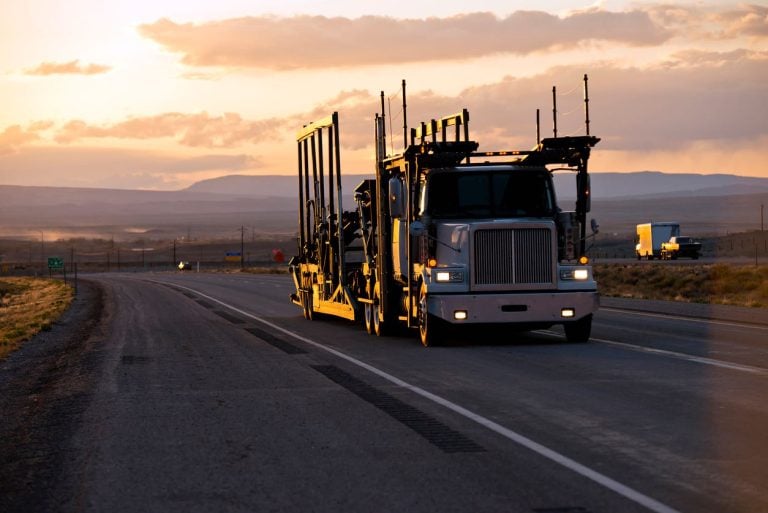
A flatbed tow truck with a tilting deck gives a shallower approach than most trailer ramps and works well for a local move or a transfer to a terminal, though it is expensive over long distance.
An enclosed trailer with a hydraulic liftgate is the proper answer for a genuinely low car. The car is driven or winched onto a platform at ground level and lifted, so the approach angle is zero. This is what collector and show cars use and it is what to ask for if the clearance measurement is small.
Winching onto the lower deck at a very shallow angle, with the car in neutral and the driver controlling the speed, is a further option on some equipment. It is slower and it is a conversation to have with the carrier rather than an assumption.
Air Suspension Needs Its Own Instructions
Air ride changes the picture in both directions and it is worth being explicit about.
The advantage is obvious: raise the car to its highest setting for loading and unloading and the clearance problem largely disappears. Tell the driver how to do it, and leave written instructions in the car if the process is not obvious.
The complication is that many air systems settle when the car is switched off, sometimes over hours. A car that loaded at 6 inches can be sitting on its bump stops by morning, which is a problem for both the car and anything under it. Say whether yours holds pressure, and if it does not, tell the carrier so the car is positioned accordingly.
Hydraulic and coilover setups are simpler. Note the current setting and whether it can be raised, and do not assume the driver knows the system.
Tie Downs Matter More on a Modified Car
How the car is secured is not a detail on a lowered vehicle, and it is worth asking about specifically.
Over the tire straps, sometimes called wheel nets or wheel straps, secure the car by its wheels and leave the suspension free to move. That is what you want. The alternative, chains or straps hooked to the chassis or suspension components, compresses the suspension for the whole trip and can bend an aftermarket control arm or crack a lip that is now sitting lower than it was designed to.

Ask for wheel straps by name. Any carrier who regularly handles modified or collector cars will have them and will not be surprised by the question.
Other Modifications Worth Declaring
Height is the common problem but it is not the only one.
Widebody kits and aggressive wheel offsets add width, which can foul the deck rails and the trailer’s own structure even when the car is well inside the legal 8 feet 6 inches for the load as a whole.
Fixed rear wings, roof scoops and tall aftermarket exhausts add height at the back and occasionally move a car off the upper deck. Removable aerodynamic parts are worth taking off and shipping inside the car.
Non standard tires, particularly slicks or very low profile setups, are worth mentioning because they behave differently on ramps and in straps.
Preparing It
Photograph everything, including the underside. On a modified car the front lip, splitter and exhaust are exactly what gets damaged, and they are exactly what nobody photographs. Get on the ground and take pictures of the front lip, the side skirts and the exhaust before the car leaves.
Leave about a quarter tank of fuel, empty the cabin, fold the mirrors, disable a motion sensitive alarm and hand over a key with any instructions the car needs.
At delivery, inspect the underside first, before you sign. That is the opposite of the usual advice and it is right for this car, because the damage that matters here is underneath. Note anything unexpected on the bill of lading while the driver is present.
Common Questions
How low is too low for an open carrier? Above about 5 inches is routine. Between 4 and 5 needs declaring and extra boards. Below 4 inches usually needs a liftgate.
Where do I measure from? The lowest fixed point, usually the front lip, splitter, exhaust or side skirt, on level ground at normal ride height.
Should I use enclosed transport? For a genuinely low car, yes, mainly because enclosed trailers commonly have hydraulic liftgates that remove the ramp angle entirely.
What about air suspension? Raise it for loading and tell the driver how. Say whether the system holds pressure overnight, because many settle when switched off.
How should it be tied down? Over the tire wheel straps, which leave the suspension free. Ask for them by name rather than assuming.
Get a Quote
Call Ship A Car, Inc. at (866) 821-4555 with the measured ground clearance, the lowest point you measured to and any suspension details, or request an estimate for the move through the quote calculator.