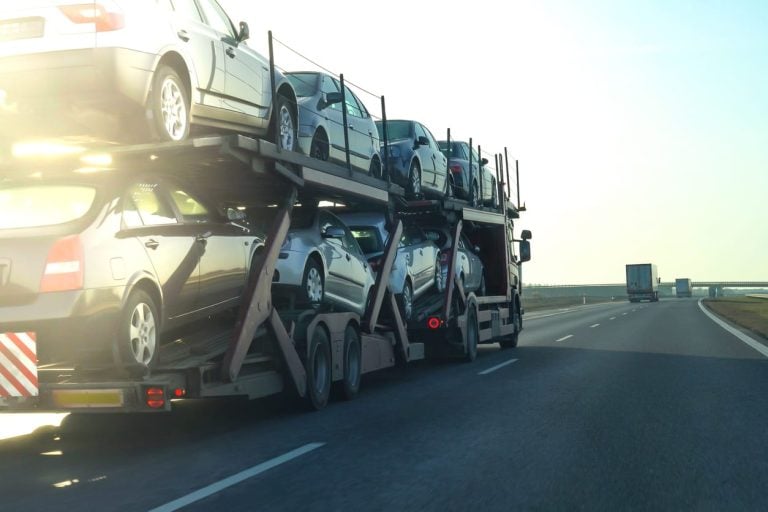
Open transport, booked with a flexible pickup window, outside peak season, on a route carriers already run. That combination is the cheapest honest way to move a car between states, and the flexibility matters more than the company you pick. Most of what people try in order to save money, chasing the lowest quote in particular, ends up costing more or costing time. Here is what genuinely lowers the number and what only appears to.
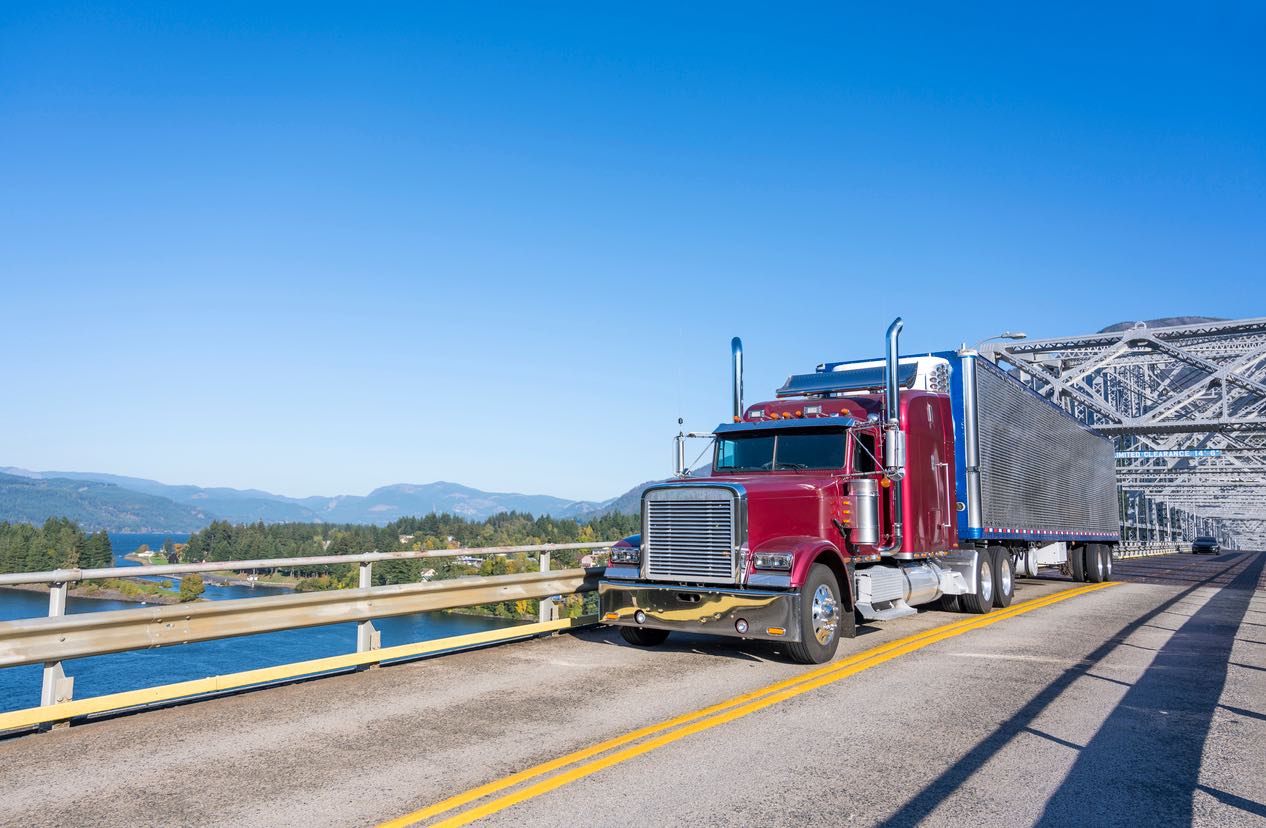
What You Should Expect to Pay
Price tracks distance, but not in a straight line. Cost per mile falls sharply the further you go, because loading, paperwork and handling are much the same whether the trip is 300 miles or 3,000.
Those are standard sedans on open transport. A full size truck or SUV adds meaningfully, a vehicle that will not start or roll adds roughly $100 to $250 for winching, and enclosed adds 20 to 30 percent.
The Levers That Actually Lower the Price
Four of them, roughly in order of how much they are worth.
Give a wide pickup window. This is the big one and it costs nothing. A three or four day range lets a dispatcher slot your car into a load that is already forming instead of routing a truck for you. A single fixed date is the most expensive way to book.
Stay on the main lanes. Carriers run continuously between major metros. If you are somewhere rural, meeting a driver in the nearest large city on a main interstate can save real money, and it often speeds up assignment too.
Avoid peak season if you can. Summer is the busiest window nationally, and January into February is the quietest on most routes. The same car on the same lane can differ by a few hundred dollars between them.
Ship more than one vehicle together. If you are moving two cars, quoting them as one booking is almost always cheaper per vehicle than two separate ones.

If You Are Crossing the Country
The cheapest miles in auto transport are long ones. Coast to coast runs $0.72 to $0.93 per mile against $1.50 or more on short hauls, because a 2,800 mile load spreads the same loading and paperwork across ten times the distance. The total is bigger but the efficiency is on your side, and the alternatives fall away: nobody adds 2,800 miles to their own odometer to save a couple of hundred dollars. The mechanics of a transcontinental move are covered in our guide to shipping a car across the country; here we only care about the price.
Two things matter more on a long route than a short one. Stay on the transcontinental lanes carriers actually run, I-10, I-40, I-80 and I-95 between major metros, because a car starting or ending far off those corridors pays for the detour. And watch the seasonal flows. In fall, snowbird traffic pushes southbound prices up while northbound trucks come back with empty spots, and the pattern reverses in spring. If your dates can ride the cheap direction of that cycle, the difference is real money.
Why the Lowest Quote Is Often the Most Expensive
This is the part worth understanding, because it is where most bad experiences start.
Almost all consumer auto transport is arranged by brokers, who post your vehicle to a national load board where carriers choose what to haul. A quote is really a prediction of what a carrier will accept. Quote too low and no carrier takes it, so the car sits, unassigned, while your dates pass.
What happens next is predictable. A week before the move you are told the price has to go up to get a truck, and by then you have no time to shop. The trip ends up costing more than a realistic quote would have, and you have lost a week.
So compare quotes on plausibility rather than on the smallest number. Ask what the price is based on, whether it is what a carrier will actually accept, and what happens if nobody takes the load. A company that explains that clearly is worth more than one that is a hundred dollars cheaper on paper.
Open Transport Is the Cheap Option and It Is Fine
Open carriers move the overwhelming majority of vehicles in this country, including nearly every new car delivered to a dealership. Your car is outdoors for the trip, which is the whole of the difference.
For an ordinary vehicle that is the right call, and paying for enclosed transport is money spent on a risk you do not really carry. Enclosed earns its premium for fresh paint, collectible or exotic cars, and unusually low ground clearance. If none of that applies, open is not a compromise.
The Cheap Alternatives, Measured Honestly
A few options surface in every search for cheap car shipping. Here is how they hold up.
Terminal to terminal. You drop the car at a yard and collect it from another. It sounds cheaper than door to door, but the saving is usually small or absent, terminals charge storage when a schedule slips, and you still arrange rides at both ends. Most brokers barely price the two apart anymore.
Driveaway services. Someone drives your car instead of hauling it. The rate looks attractive until you count 2,000 miles of fuel, wear and depreciation on your own vehicle, with a stranger at the wheel under insurance terms worth reading twice. For most cars the arithmetic loses to open transport for the same reasons driving it yourself does.
The Auto Train. Amtrak moves you and your car between Lorton, Virginia and Sanford, Florida, and on that one lane it is genuinely cheap if you were making the trip anyway. No equivalent exists for any other route in the country, so for everyone else the train is not an option.
A tow dolly behind a rental truck. Reasonable only if you are already driving the truck across the country. As a way to move a car on its own it is slow, hard on the vehicle and rarely cheaper once the rental, fuel and lodging are counted.
What Not to Cut
A few savings are false ones.
- Do not skip the condition report. Walking the car with the driver and photographing it takes ten minutes and is the only thing that establishes what the vehicle looked like at pickup.
- Do not load it with belongings to save on movers. Carriers are not licensed to haul household goods, weight affects the load, and personal items are not covered by cargo insurance.
- Do not choose on price alone without checking the company. Verify the USDOT number and look at recent reviews rather than the count.
- Do not pay a large deposit up front. Normal practice is a modest deposit or nothing until a carrier is assigned.

Is Driving It Yourself Cheaper?
Sometimes, and less often than people assume. Under roughly 500 miles, driving usually wins if you have the time.
Beyond that the arithmetic turns. A 1,500 mile drive is two or three days of fuel, two nights of lodging, meals, the working days you give up and 1,500 miles of wear on a car you will eventually sell. Add a one way flight back if the car is not staying with you. Count all of it honestly and transport is frequently the cheaper option, not just the easier one.
Common Questions
What is the single cheapest way? Open transport with a flexible pickup window, booked off peak, on a route between major metros.
Does booking earlier make it cheaper? It makes assignment easier and reduces the chance of a last minute price rise. Two to three weeks is comfortable, three to four in summer.
What is the cheapest month to ship a car? January and February on most lanes, after holiday traffic clears and before spring moves begin. The exception is the snowbird corridors into Florida and Arizona, where fall runs hot southbound and the cheap direction flips with the season.
Why do quotes vary so much? Because a quote is a prediction of what a carrier will accept, not a fixed rate. Very low quotes often fail to get a truck.
Is a cheaper company less safe? Not necessarily, but check the USDOT number and insurance regardless of price.
Get a Quote
Call Ship A Car, Inc. at (866) 821-4555 and tell us how flexible your dates are, since that is what moves the price, or run the numbers with the instant calculator.