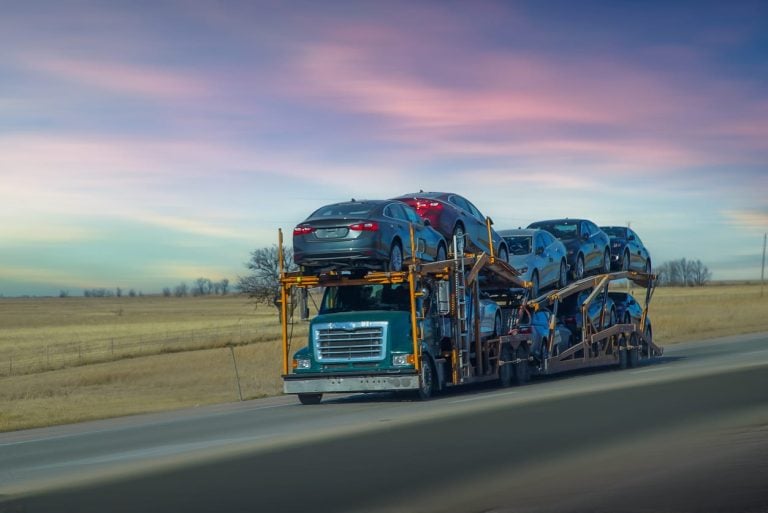
Shipping Your Car vs Driving It Yourself
Driving your own car to a new state feels free and is not, and the honest comparison only works once you count the costs that do not arrive as a bill. Fuel is the obvious one and usually the smallest. Lodging, meals, the mileage you put on the car and the days of your own life are the rest, and on a long move they add up to more than most people expect before they do the arithmetic.

Count the Drive Properly
Work through six line items and use real numbers rather than optimistic ones.
Fuel first: take the actual distance, divide by your car’s real world economy rather than its best figure, and multiply by a realistic pump price. Long interstate driving is kinder to economy than city driving, so this is the one line that usually comes in reasonably.
Lodging next, and this is where estimates go wrong. A sensible driving day is 500 to 600 miles, not 900. A coast to coast trip is therefore three to five nights, not two, and each of those is a room.
Then meals on the road for however many days that is, for however many people are traveling.
Then vehicle wear. A 2,500 mile trip is a meaningful fraction of a year’s driving for most people, and it brings a service interval forward. Whether or not you sell the car, those miles have a value.
Then risk: a breakdown far from home, a windshield chip, or a tire on an unfamiliar road all cost more away than at home.
Finally your own time, at whatever a day of it is worth to you. For most people this is the largest number on the list and the one they leave out.
When Driving Genuinely Wins
Plenty of situations favor the drive, and pretending otherwise would be dishonest.
Short moves win clearly. Under roughly 500 miles, shipping rarely makes financial sense: the per mile rate is at its highest on short lanes and the drive is a single day.

A move where you want the car with you throughout, or where you are carrying belongings you would otherwise pay a mover to take, tilts the same way. So does a trip you actually want to take, because a scenic drive is a holiday rather than a cost if you treat it as one.
And if you have plenty of time and the car is old enough that miles no longer matter much to its value, driving is the cheaper answer.
When Shipping Wins
The reverse cases are equally clear once the arithmetic is done.
Long distance is the main one. Past roughly 1,000 miles the drive costs several days and several nights of accommodation, and the shipping quote starts to look modest by comparison.
Multiple vehicles is another. A household with two cars cannot drive both, so somebody either makes two trips or one car ships anyway.
Any vehicle you would rather not add miles or road exposure to belongs on a truck: a collector car, a low mileage vehicle, something recently restored or newly purchased.
Families with children or pets, anyone on a work deadline, and anyone flying to the destination anyway all come out ahead shipping. And a car bought remotely has to move somehow, and flying out to drive it back is a trip plus an airfare.
What About Towing It Yourself?
A third option exists and it deserves a hard look before anyone commits to it, because it is frequently the worst of the three.
Renting a tow dolly or a car trailer and pulling the vehicle behind a moving truck sounds economical, and the rental price genuinely is low. What it adds is a combination you have probably never driven, a much longer stopping distance, no reversing to speak of with a dolly, and fuel economy on the moving truck that drops sharply under load.
It also concentrates risk. A car on a dolly has its rear wheels on the road, which is fine for some drivetrains and not for others, and getting that wrong damages a transmission. Loading and securing it correctly is a skill, and an incorrectly strapped vehicle is a hazard to everyone behind you.
Where it does make sense is a short move where you have already rented the truck for household goods and you are comfortable with the driving. Over a long distance, with an unfamiliar rig and mountain grades, the saving is small and the exposure is not.
The Hybrid Option
Most people frame this as a binary and it is not.
Shipping one car and driving the other splits the difference for a two car household, and it is what a great many relocating families actually do.
Flying one way and shipping the car is the other common arrangement: you arrive rested on the day you choose, and the car follows. On a long move the airfare is frequently less than the lodging you avoid.

A Worked Comparison
Take a 2,000 mile move as an illustration rather than a quotation, since your numbers will differ.
Driving means roughly four days at 500 miles a day. That is fuel for 2,000 miles at your car’s real economy, three nights of lodging, four days of meals, 2,000 miles of wear, and four days of your time. Add a contingency for anything going wrong.
Shipping means a quote for the lane, plus an airfare if you are not already flying, plus a few days where you do not have the car at the destination.
Run both with your own figures before deciding. On a short move the drive usually wins outright; on a long one with a family, shipping frequently wins even before you count your time. Our guide to keeping shipping costs down covers how to get the quote side lower.
If You Decide to Ship
Book two to three weeks ahead and give a range of pickup days rather than a single date. Flexibility is the largest lever on price you control.
Choose open transport unless the car is a collector vehicle, has fresh paintwork or a wrap, or sits low enough that standard ramps are a risk.
Wash it so existing marks are visible, photograph every panel in daylight, leave about a quarter tank of fuel and empty it completely. At delivery, inspect before signing and note anything unexpected on the bill of lading while the driver is present.
Common Questions
At what distance does shipping start to win? Broadly past 1,000 miles, and sooner with a family, a second vehicle or a car you do not want to add miles to.
What do people forget to count? Lodging, meals, vehicle wear and their own time. Fuel is usually the smallest line on the list.
Is driving cheaper on a short move? Almost always. Under about 500 miles the per mile shipping rate is at its highest and the drive is one day.
Can I do both? Yes, and many households do: ship one car and drive the other, or fly and have the car follow.
Does shipping add mileage? No. The vehicle travels on a truck and arrives with the miles it left with, aside from loading and unloading.
Get a Quote
Call Ship A Car, Inc. at (866) 821-4555 with both zip codes and a range of dates so you can compare a real number against the drive, or use the instant calculator.